Key points
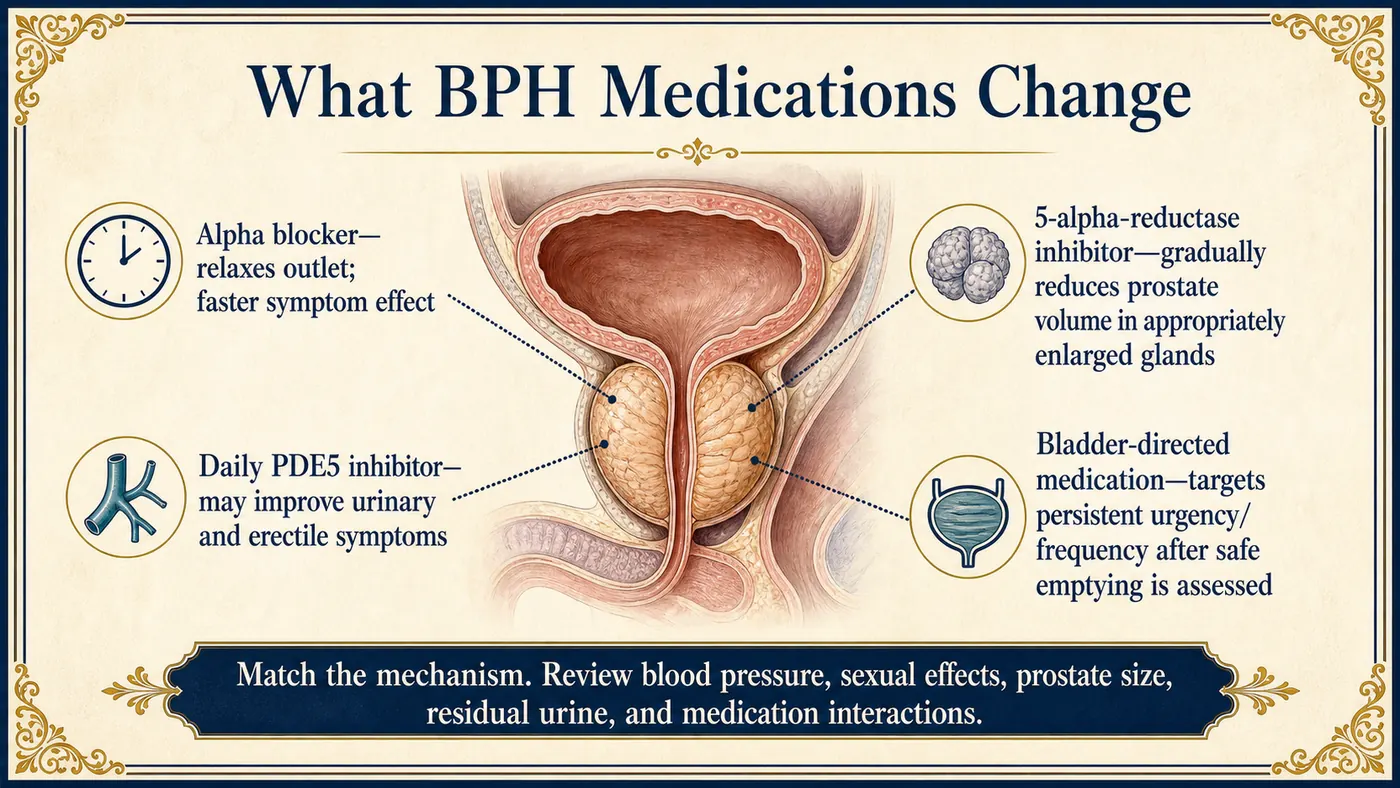
- Alpha blockers relax the outlet and can help within days; 5-alpha-reductase inhibitors shrink suitable glands over months.
- A drug can improve the stream and still be unacceptable if its cost conflicts with what you want to preserve.
- 5-alpha-reductase inhibitors lower PSA, so a rise from the treated baseline still deserves attention.
- Daily tadalafil can serve urinary and erectile goals but is not safe with nitrates.
- Before bladder-calming drugs are added, safe emptying should be confirmed.
- No medication should become permanent through inertia; follow-up can continue, adjust, combine or move on.
A pill that “works” may still not be right
A man’s stream can improve within days of starting a prostate medication while ejaculation changes enough to affect his relationship. On a symptom score, the treatment succeeded. From his point of view, it did not. That is the central truth about BPH medication: improvement is not meaningful if its cost conflicts with what you are trying to preserve. The best prostate medication is not the strongest pill. It is the one whose mechanism matches your prostate, bladder, risks and priorities.
What each drug is actually trying to change
- Alpha blockers relax smooth muscle at the prostate and bladder outlet. They can improve flow and symptoms relatively quickly, but they do not substantially shrink the gland or remove long-term progression risk. Dizziness, low blood pressure, fatigue, nasal congestion and ejaculation changes vary by drug and person. Tell your eye surgeon about current or past use before cataract surgery, because some drugs in this class can affect the iris during the operation.
- 5-alpha-reductase inhibitors change the hormonal pathway that supports prostate growth. In appropriately enlarged glands they reduce volume gradually and lower the risk of retention or future surgery. They need patience: benefit develops over months, not days. Reduced libido, erection or ejaculation changes, breast symptoms and mood concerns should be discussed before you start, not discovered afterward.
- Combination therapy pairs the two for earlier relief and lower long-term progression risk in selected men. It also combines both drugs’ side effects, so it makes most sense when anatomy and risk justify it.
- Daily tadalafil may improve urinary symptoms and erections in some men, which is appealing when both matter. It is not safe with nitrates and requires attention to heart status, blood pressure and interacting medicines. A drug that serves two goals can simplify treatment; it should not bypass basic safety screening.
- Bladder-directed medications may be considered when urgency and frequency persist after the outlet has been evaluated. Before reducing bladder contractions, your urologist should know whether you empty safely; suppressing storage symptoms in someone with substantial residual urine can create the wrong balance.
The PSA effect
5-alpha-reductase inhibitors lower PSA. That does not make PSA unusable, but it must be read in light of the medication, how long you have taken it, your baseline and your trend. A falling PSA may be expected. A concerning rise from the treated baseline still deserves attention.
Three questions that make the choice logical
Do you want faster symptom relief? Do you want to reduce progression risk in an enlarged gland? Do you need to address a persistent bladder-storage problem once emptying has been checked? When those questions are separated, the medication choice becomes much clearer. The conversation should also include sexual function, blood pressure, cataract plans, fertility goals, your other prescriptions and how willing you are to take long-term therapy.
What medication failure actually means
Before declaring that a drug has failed, reconstruct what happened. Was it taken consistently? Was there enough time for its mechanism to work, especially for a gland-shrinking drug that cannot act within a week? Did it improve the stream but leave nighttime urination unchanged because sleep or nighttime urine production was the real driver? Did you quietly stop it because of dizziness or sexual effects you never reported?
This matters most when several symptoms have been grouped under the word “prostate.” An alpha blocker may reduce outlet resistance while urgency persists from a separate bladder problem. A gland-shrinking drug may lower long-term risk without the dramatic early change you expected. Neither is necessarily failure. It may be partial success, a mismatch between drug and symptom, or a sign that more than one mechanism is present.
Name side effects precisely
Side effects deserve the same precision as benefits. Lightheadedness on standing is different from general fatigue. Reduced semen volume is different from erection trouble or low desire. Breast tenderness, mood change, nasal congestion and blood-pressure effects should be named, timed and linked to the medication, not accepted vaguely as the price of aging.
Continue, adjust, combine or move on
At follow-up there are usually four rational choices: continue a helpful drug, adjust the strategy, combine treatments that serve distinct goals, or move toward a procedure. Follow-up asks whether symptoms improved, side effects appeared, residual urine changed, infections or retention occurred, and whether you still prefer pills. Moving to a procedure does not mean medication was a mistake; a pill may have provided years of useful control before anatomy, bladder function or priorities changed.
Medication burden itself counts: refills, interactions, blood-pressure monitoring, sexual effects and uncertainty about missed doses. For some men, a well-tolerated pill is simpler than a procedure. For others, a durable anatomical treatment offers more freedom. The right comparison is the total burden, benefit, risk and reversibility of each path for you now.
Supplements
“Natural” does not establish effectiveness, purity or freedom from interactions. If you use a supplement, put it on your medication list and hold it to the same standard: what is the target, what evidence supports it, how will you know it helped, and what might it delay?
Questions to ask your urologist
- What is this medication meant to change, and how soon should I notice it?
- Which side effects matter most given my other conditions and medicines?
- How will my PSA be interpreted if I take a 5-alpha-reductase inhibitor?
- Has my emptying been checked before adding a bladder medication?
- When will we decide whether to continue, stop or move to another treatment?