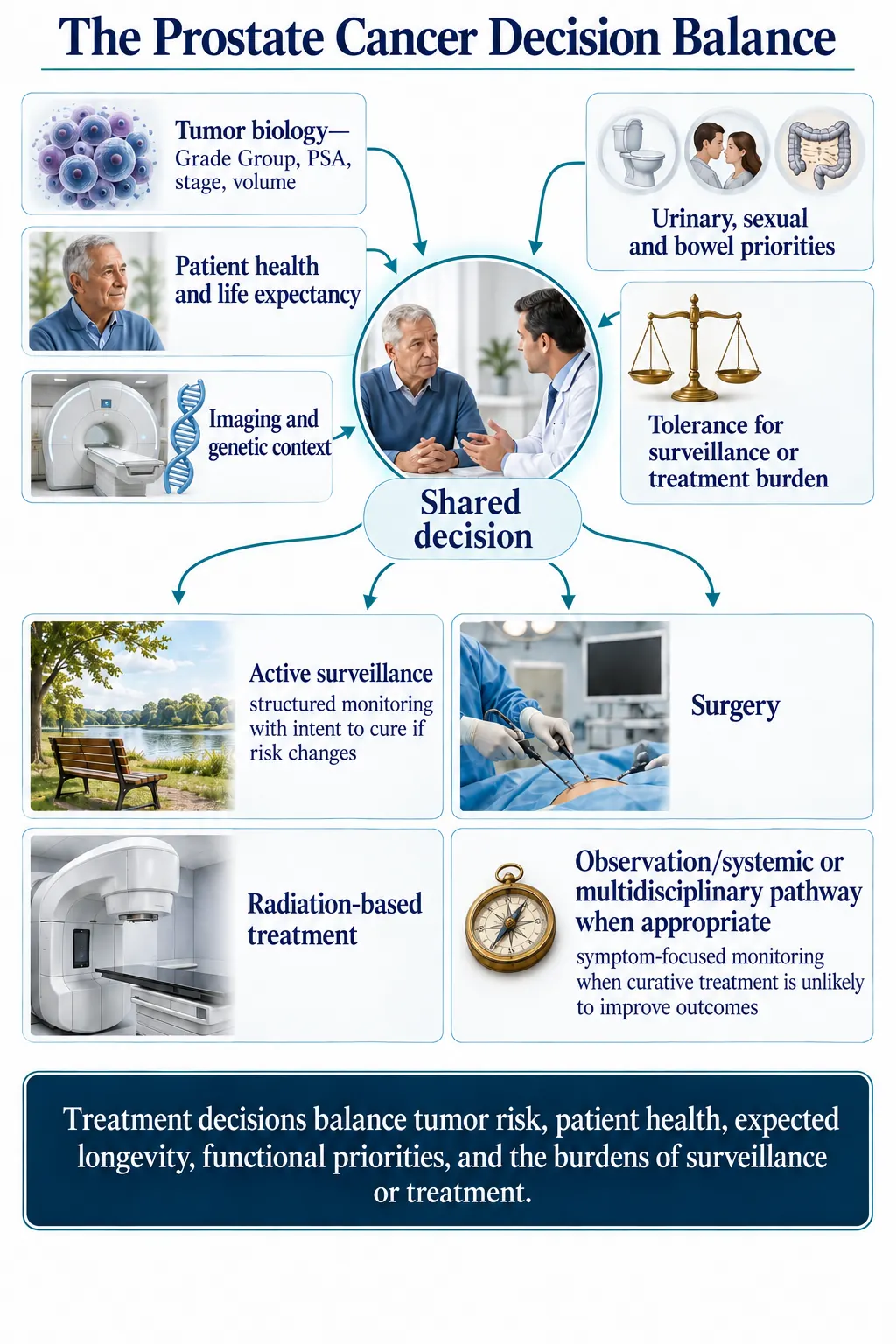
Key points
- The word cancer is the same; the biology is not. Grade Group, PSA, stage, biopsy findings and scans define risk.
- Active surveillance is an active program with planned checks, and treatment remains available if risk changes.
- Watchful waiting is different: it focuses on symptoms when curative treatment is unlikely to help.
- Surgery and radiation can each control appropriately selected localized cancer, with different side-effect profiles.
- Focal therapy may suit carefully selected men, but it is not a risk-free middle ground.
- Judge side effects against how you function now, and plan beyond the first treatment.
Treat the risk, not the word cancer
Two men can both be told they have prostate cancer and face entirely different decisions. One has a small volume of Grade Group 1 disease, a favorable PSA pattern and many years of expected life. Another has high-grade cancer extending beyond the gland. The same diagnosis can justify surveillance in one man, curative treatment in another and observation focused on comfort in a third.
To judge the risk, your team looks at the cancer’s Grade Group, PSA, stage, biopsy findings, scans and other useful test results. They then ask how your health and expected lifespan affect the threat from this cancer. Your priorities help choose among the options that fit those findings. Higher-risk cancer may need prompt action. Lower-risk cancer often leaves time to confirm the findings, understand the options and make a considered choice. The emotional intensity of the word cancer should not be allowed to erase the biology.
The main pathways
Active surveillance is an active program, not neglect. It is preferred or appropriate for many low-risk cancers, because immediate treatment may expose you to urinary, sexual and bowel effects without improving the outcome that matters. Surveillance typically uses PSA, clinical review, MRI and repeat tissue assessment on a schedule tailored to risk. Treatment remains available if the biology appears more aggressive or your circumstances change.
Watchful waiting is different. Its purpose is not repeated testing with an expectation of cure. It is generally used when age, frailty or other illness makes the burdens of cure unlikely to provide meaningful benefit, and care focuses on symptoms and complications if they develop. Neither strategy is passive or careless when appropriately selected.
Radical prostatectomy removes the prostate and seminal vesicles and allows complete pathologic examination. It can provide excellent cancer control for appropriately selected localized disease. Its principal quality-of-life risks are urinary incontinence and erectile dysfunction, with outcomes influenced by baseline function, age, anatomy, cancer extent, nerve preservation, surgical technique and rehabilitation. Surgery creates a clear PSA expectation afterward, but it is not always more complete or more courageous than radiation.
Radiation treats the prostate in place through external-beam techniques, brachytherapy or selected combinations. Depending on risk, hormone therapy may be added for a defined period. Urinary irritation, bowel symptoms, fatigue, erectile decline over time and secondary effects need discussion. Radiation is not one treatment; technique, dose, schedule, target, hormone use and anatomy all matter.
Focal therapy aims to treat a selected tumor region while preserving more surrounding tissue. It may reduce some functional burdens in carefully selected men, but long-term comparative evidence, surveillance requirements, untreated microscopic disease and later treatment options must be discussed candidly.
Higher-risk or more advanced disease may need combinations of radiation, surgery in selected contexts, hormonal therapy, systemic treatment or multidisciplinary planning. Inherited and tumor genetic testing can become relevant. A coordinated team of urology, radiation oncology, medical oncology, radiology, pathology, genetics and primary care can improve the decision.
Translate side effects into daily life
“Incontinence risk” means pads, leakage with exertion, possible procedures and changes in confidence. “Erectile dysfunction” means your baseline erections, medication response, recovery uncertainty, intimacy and the potential need for devices, injections or implants. “Bowel toxicity” means urgency, bleeding, discomfort and day-to-day unpredictability. Consent becomes meaningful only when the words connect to your life.
Begin with the function you have now
Before choosing treatment, your urologist needs to know how you function now: urine control and pad use, stream strength and urgency, bowel habits, erections and what helps them, orgasm, ejaculation and concerns about intimacy, as well as your strength and willingness to take part in recovery care. A side effect should be judged against your actual starting point.
Baseline function also changes the meaning of preservation. Nerve-sparing surgery cannot be discussed apart from tumor location and existing erections. Radiation urinary effects matter differently with severe obstruction than with effortless emptying. A man already using pads faces a different continence decision from someone whose work requires heavy lifting and complete dryness.
Surveillance needs an operating plan
If you choose active surveillance, leave knowing who follows your PSA, when MRI will be repeated, when repeat biopsy is recommended, and which changes would lead to treatment rather than just confirmation. A surveillance label without ownership and triggers can drift into neglect. The plan should be revisited when your health or preferences change; surveillance is a strategy continually matched to risk, not a lifelong contract.
Plan beyond the first treatment
Every curative pathway should include a recovery and contingency conversation. After surgery, that may include continence training, erectile rehabilitation, pathology review, PSA monitoring and when more radiation would be considered. After radiation, it may include managing urinary or bowel symptoms, sexual health, hormone-related effects, PSA interpretation and options if the disease returns. Thinking about later treatment does not predict failure. It keeps the first decision from being made as though no second decision could arise.
When to get a second opinion
Second opinions are especially valuable when several curative options are reasonable, when focal treatment is being considered, when imaging and pathology disagree, or when the recommending clinician offers only one pathway. Hear from the relevant disciplines. A good second opinion does not merely confirm the diagnosis; it tests the assumptions behind the recommendation.
Questions to ask your urologist
- What is my cancer’s risk category, and what is its expected course?
- Is active surveillance reasonable for me, and if so, who runs it and what would trigger treatment?
- Which surveillance, surgical, radiation, focal and systemic options fit my situation?
- How could each option affect urination, erections, bowel function and recovery, given how I function now?
- How would this first treatment shape my options if the cancer returned?
- Should I hear from a radiation oncologist or another specialist before deciding?