Key points
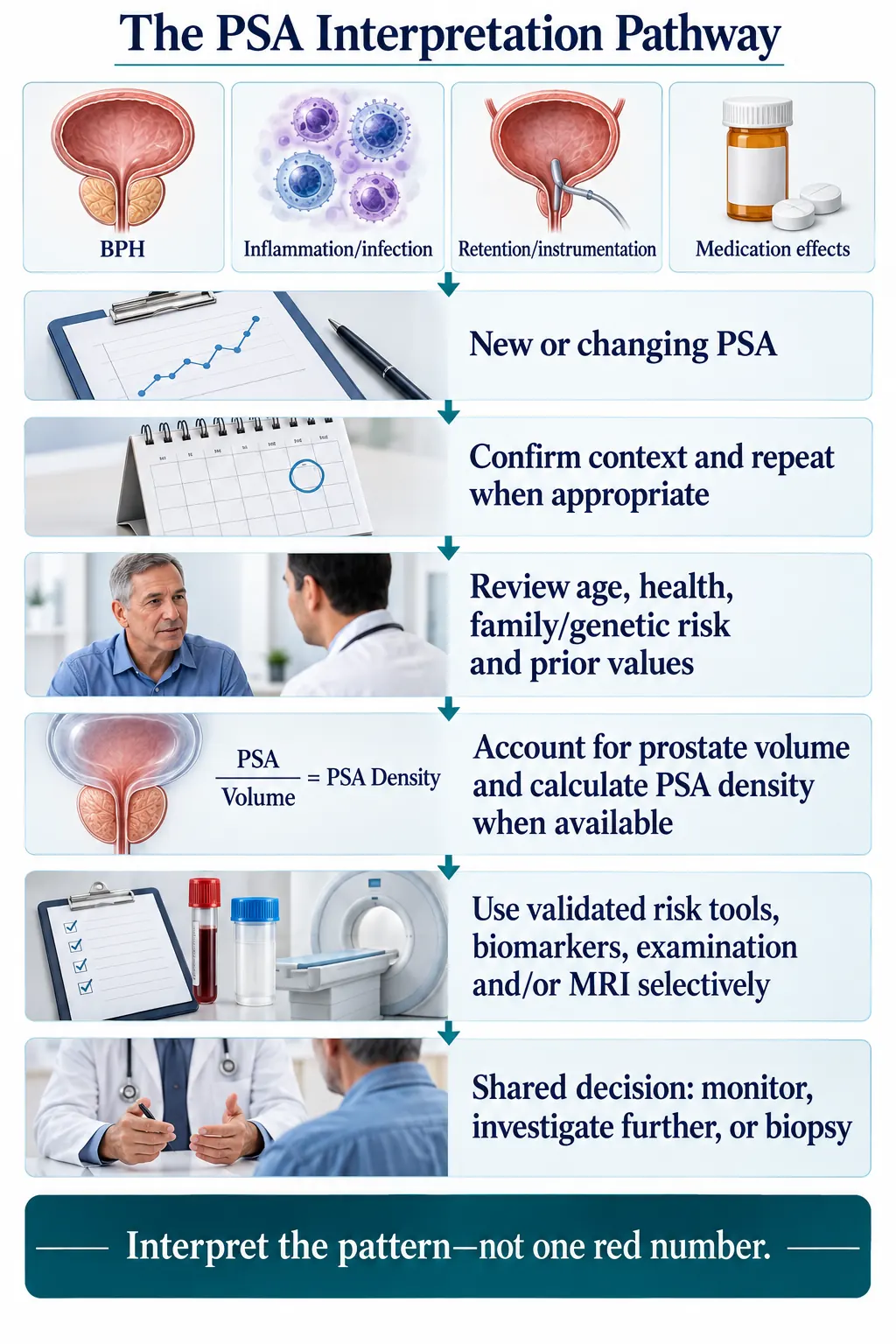
- PSA can rise with benign enlargement, inflammation, infection, recent instrumentation and urinary retention, not only cancer.
- Confirming a newly elevated PSA before escalating is quality control, not dismissal.
- PSA density relates PSA to prostate size; the same value means different things in large and small glands.
- An MRI PI-RADS score estimates suspicion; it is not a Gleason grade, Grade Group or stage.
- Active surveillance is an active program, not neglect, and is appropriate for many low-risk cancers.
- Treat the risk, not the word cancer.
A risk signal, not a cancer verdict
A lab portal marks your PSA in red, and before you speak with anyone you have imagined a biopsy and cancer treatment. Yet a repeat test, after a temporary urinary problem has resolved, can fall substantially. The original result was meaningful, but not in the way you feared.
Prostate-specific antigen is a protein made by prostate tissue. Cancer can raise it, and so can benign enlargement, inflammation, infection, recent instrumentation, urinary retention and other temporary influences. Some prostate cancers make relatively little PSA, while some very large benign glands make a great deal. A value below a familiar threshold does not rule out cancer, and one above it does not prove cancer. Risk lies on a continuum.
Interpreting the number
- Confirm it. When a PSA is newly elevated and nothing urgent changes the sequence, repeating it, timed after any temporary cause has resolved, can prevent a cascade of tests based on a passing value.
- Look at the trend, but not as a stopwatch counting toward biopsy. Change must be read alongside the starting value, gland size, lab variability and recent events.
- Account for size. PSA density relates PSA to prostate volume. It is helpful, not absolute.
- Be specific about family history. A father diagnosed late in life with low-risk disease differs from several close relatives with young or aggressive prostate, breast, ovarian or pancreatic cancers. Ancestry and inherited variants can also matter.
- Know your medications. Drugs that shrink the prostate lower PSA, changing both the value and the meaning of its trend.
Additional blood or urine markers and MRI can refine risk, but before ordering them, ask how each possible result would change your care. The useful test is the one that moves a real decision. Screening itself should be a shared decision: the benefit is earlier detection of cancers likely to cause harm; the harms include false alarms, biopsy complications and treatment of cancers that may never have threatened your life.
MRI and biopsy
MRI improves the map; biopsy establishes the tissue diagnosis. Radiologists summarize MRI suspicion with PI-RADS, a scale from very low to very high likelihood of clinically significant cancer. It is not a grade or stage. A highly suspicious area can prove benign, and a reassuring scan can miss cancer. Image quality and reader expertise matter.
A targeted biopsy aims at a suspicious lesion; systematic sampling covers predefined regions that may hold cancer MRI cannot see. They are often combined. Biopsy can go through the rectum or through the skin of the perineum. The transperineal route avoids passing the needle through rectal bacteria and may reach some regions better, while transrectal biopsy remains in use with infection-prevention protocols. Expect temporary blood in the urine or semen, soreness and urinary symptoms. Never stop a blood thinner without a coordinated plan, and arrange beforehand who will explain your results so you are not decoding a portal report alone.
The pathology report gives a Grade Group, how abnormal and aggressive the cells look, along with how much cancer was found and where. A biopsy samples the prostate; it does not examine the whole gland. A negative biopsy lowers risk without always ending follow-up. When the MRI and biopsy disagree, the next step should fix the weakest link, whether the image, the sample or the interpretation, rather than restart everything.
Treat the risk, not the word cancer
Two men told they have prostate cancer can face entirely different decisions: one with a small amount of Grade Group 1 disease and many years ahead, the other with high-grade cancer extending beyond the gland. Risk is judged from Grade Group, PSA, stage, biopsy findings and scans, then weighed against your health, life expectancy and priorities.
- Active surveillance uses scheduled PSA, review, MRI and repeat tissue checks for many low-risk cancers, with treatment available if the cancer looks more aggressive. You should leave knowing who follows you and which changes would trigger treatment.
- Watchful waiting focuses on symptoms when age, frailty or other illness make curative treatment unlikely to help.
- Radical prostatectomy removes the prostate and seminal vesicles. Its main quality-of-life risks are urinary leakage and erectile dysfunction.
- Radiation, external-beam, brachytherapy or a combination, sometimes with time-limited hormone therapy, can cause urinary, bowel and gradual erectile effects.
- Focal therapy treats a selected region in carefully chosen patients, but long-term evidence, follow-up needs and salvage options must be discussed candidly.
- Higher-risk disease may need combined treatment and a team that includes urology, radiation oncology, medical oncology, radiology, pathology and genetics.
Translate side effects into daily life: pads and confidence, erections and intimacy, bowel urgency. Compare them with how you function now. High-risk biology may make timely treatment important; low-risk disease usually leaves time to confirm findings and get a second opinion, especially if your clinician offers only one pathway.
Questions to ask your urologist
- Should my PSA be repeated before we take another step?
- How do my trend, prostate volume, medications and family history affect my risk?
- What decision would a biomarker or MRI change for me?
- Why does the proposed biopsy route and sampling plan fit my situation, and who will explain the results?
- What is my cancer’s risk category, and have we discussed surveillance, surgery, radiation, focal and systemic options?
- How could each option affect urination, sex and bowel function compared with how I function now?