Key points
- Urination needs the bladder (the pump) to contract while the outlet relaxes.
- Prostate size alone does not determine obstruction; shape, the bladder neck and the bladder’s response matter.
- Opening the outlet does not guarantee improvement if the bladder muscle is weak.
- Uroflow must be read with the voided volume; a small void can look like poor flow.
- Urodynamics can prevent the wrong operation when symptoms, flow, residual and anatomy do not line up.
- Before we open the outlet, we must understand the pump.
A weak stream is not a prostate diagnosis
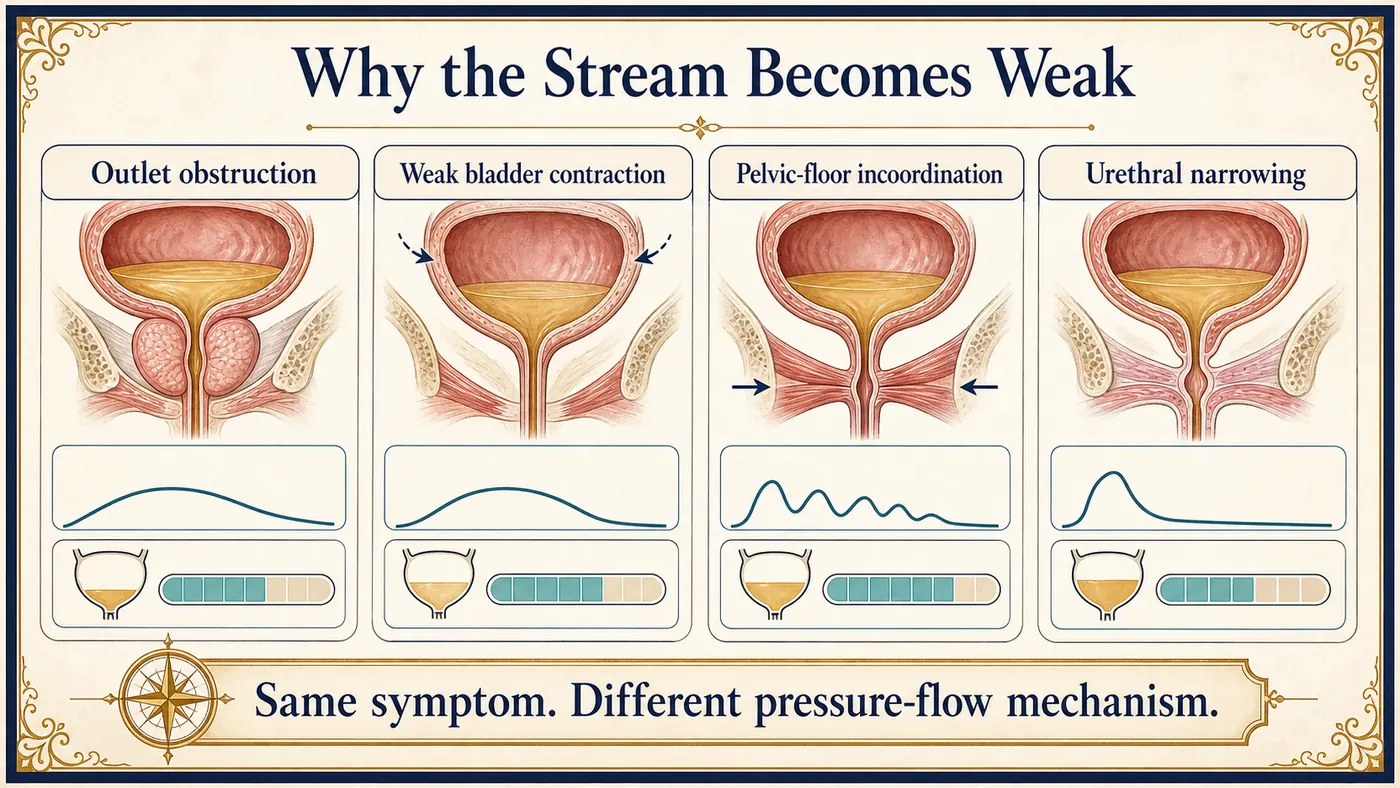
Waiting at the toilet, straining to start, a stream that weakens, stops and starts again, and the feeling you are not truly empty: many men assume this means a huge prostate. Sometimes the prostate is the cause. But a weak stream is a description of how urine leaves the body. To understand it, a urologist needs to know whether the outlet is too resistant, the bladder muscle is too weak, the pelvic floor is failing to relax, the urethra has narrowed, or the nerves are no longer coordinating the process.
The pump-and-outlet model
Think of urination as a pump working against an outlet. The bladder muscle is the pump. The bladder neck, prostate channel, urethra and pelvic floor form the outlet. For normal urination, the pump must contract while the outlet relaxes. If the outlet is resistant, the bladder has to push harder. If the bladder weakens, the stream can be poor even when the outlet is open. If the pelvic floor tightens instead of relaxing, flow becomes hesitant or interrupted. If scar tissue narrows the urethra, even a strong bladder struggles. To you, each feels similar. For treatment, they are not similar at all.
Why prostate size is not the diagnosis
Some men have very large prostates and little trouble emptying. Others have smaller glands shaped in a way that blocks flow, such as a middle lobe projecting into the bladder, a tight bladder neck or an elongated channel. The bladder’s response matters too: a strong bladder may compensate for years, while a weaker one becomes symptomatic with much less resistance. Two men with the same 60-gram prostate can have completely different situations: one with strong flow and mild symptoms, the other with low flow, high residual urine, infections and bladder changes. A procedure should never be recommended on size alone.
Other causes
A weak bladder muscle. Aging, long-standing obstruction, diabetes, neurologic or spinal disease, overstretching, medications or prior pelvic surgery can weaken it. A technically successful prostate procedure may still leave poor emptying if the pump is weak.
Pelvic-floor dysfunction. Urination requires relaxation. Pain, anxiety, learned habits, prior surgery, trauma and chronic muscle tension can make the pelvic floor tighten during voiding, causing hesitancy, interrupted flow, straining and a sense of incomplete emptying in men and women alike. Pelvic-floor physical therapy may be the right treatment when coordination is the main problem.
Urethral stricture. Scar tissue from trauma, infection, catheters, instruments, surgery or inflammation, or sometimes no remembered cause, can narrow the urethra. It may cause a weakening, spraying or split stream, prolonged urination, infection or retention. Treatment targets the narrowed segment, not the prostate, and is matched to its location, length and history. Options may include dilation, internal incision, a drug-coated balloon for selected short, recurrent strictures, or reconstruction. A less invasive option may mean faster recovery but is not always the most durable choice, so that trade-off should be discussed openly.
Medications and nerves. Anticholinergic drugs, some antihistamines, decongestants, opioids and sedatives can worsen emptying in susceptible people. Diabetes, spinal disease, multiple sclerosis, Parkinsonian disorders, stroke and nerve injury can alter bladder function. The bladder sometimes reveals a nerve problem before you notice it elsewhere.
The tests, and what each answers
- Uroflow records your stream over time. The curve’s shape matters as much as peak flow: smooth and bell-shaped suggests coordinated emptying; prolonged and flat suggests resistance or weak contraction; interrupted suggests straining or poor coordination.
- Post-void residual, measured by ultrasound, shows how much urine remains. Repeated or markedly high results matter more than one borderline reading.
- Ultrasound can show the kidneys, bladder wall, stones, diverticula and prostate, but not whether the bladder contracts normally.
- Cystoscopy looks directly at the urethra, prostate channel and bladder. It answers anatomy, not bladder strength.
- Urodynamics measures bladder pressure and outlet resistance. It helps tell true obstruction from a weak bladder, which is especially important before surgery when the findings do not line up.
When weak flow becomes urgent
A gradually weakening stream usually allows a structured office evaluation. Sudden complete inability to urinate does not; retention with severe bladder discomfort needs prompt drainage. Weak flow with fever, flank pain, confusion, new neurologic symptoms, heavy bleeding or rapidly worsening kidney function needs urgent assessment.
Treatment follows the mechanism
If prostate obstruction is the cause, options include medication, minimally invasive therapy or surgery, depending on severity, anatomy, bladder effects and your priorities. A stricture is treated at the stricture. A weak bladder may be managed with timed or double voiding, medication review, catheter strategies or treatment of underlying disease. Pelvic-floor problems call for therapy and retraining. If a medication is contributing, the regimen may need adjusting with your prescriber. The better question is not which prostate procedure gives the strongest stream, but what is preventing your bladder from emptying normally.
Questions to ask your urologist
- Do my findings point toward obstruction, a weak bladder, pelvic-floor dysfunction or urethral narrowing?
- What do my flow pattern and residual urine show?
- Does my prostate anatomy actually match my symptoms?
- If cystoscopy or urodynamics is proposed, how could the result change my treatment?
- What are the risks of watching this, and how will we tell real improvement from a better sensation of flow?