Key points
- Frequency is a counting word, not a diagnosis.
- The volume of each void matters: small frequent voids point toward storage, emptying or irritation; large voids point toward the kidneys making too much urine.
- A two- or three-day bladder diary replaces memory with evidence and can answer questions a sophisticated image cannot.
- A normal urinalysis does not mean nothing is wrong; it redirects the workup.
- A bladder-storage medication cannot solve a problem caused mainly by excess urine production.
- Fluid timing matters more than indiscriminate fluid restriction.
The bladder is often the messenger
Most people who urinate too often assume something is wrong with the bladder. Often, the bladder is only the messenger. Frequent urination is not a diagnosis. It is a message that something about urine production, bladder storage, emptying, sensation, sleep, medication, metabolism or behavior has changed.
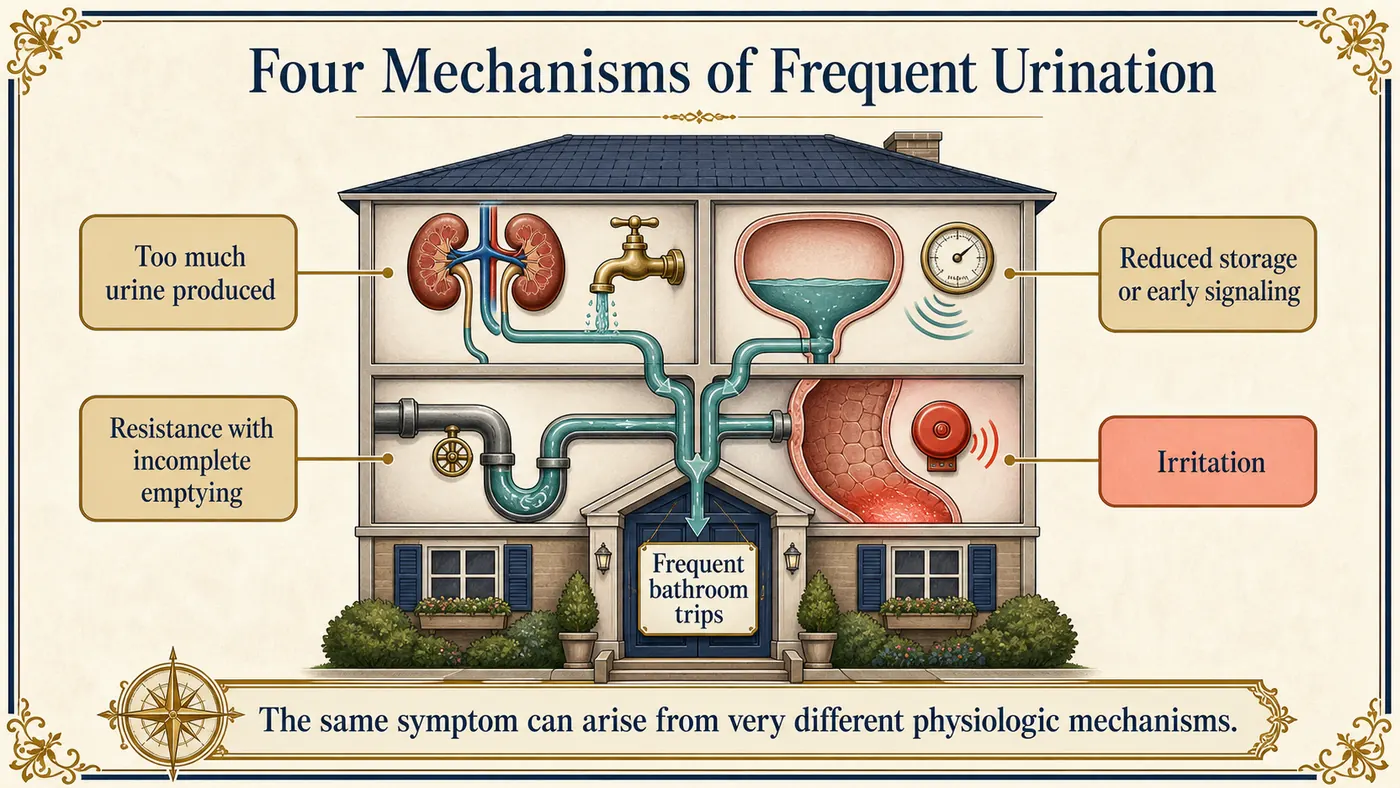
A simple way to picture it is a house’s plumbing. The kidneys are the water supply. The bladder is the storage tank. The urethra, and in men the prostate around part of it, is the drainpipe. The nervous system is the pressure sensor that tells the brain how full the tank is. If too much water enters, the tank empties more often. If the drainpipe is partly blocked, the tank never fully empties. If the sensor becomes oversensitive, it sounds the alarm before the tank is full. If the lining is irritated, the system signals urgency at a small volume. From outside the house, every one of these looks the same: repeated trips to the bathroom.
One question that changes everything
When you urinate, is it a little or a lot? Many people have never noticed. Yet the volume of each void often changes the entire diagnostic path. Small, frequent voids suggest a storage problem, incomplete emptying or irritation. Large voids suggest the kidneys are producing too much urine. The symptom feels identical; the physiology is completely different.
The four mechanisms
Producing too much urine. Sometimes the bladder works normally and simply receives more urine. Diabetes can raise urine output when glucose spills into the urine and pulls water with it. Diuretics increase output by design. High fluid intake, caffeine, alcohol, some kidney disorders and less common hormonal conditions can contribute. Some people make a large share of the day’s urine at night because of sleep apnea, fluid returning from swollen legs, medication timing or other conditions.
A bladder that speaks too soon. You may make a normal amount of urine but feel the urge at low volumes. The sensation is real. In many cases the bladder has not literally shrunk; it has become less tolerant of filling, or the bladder-brain communication has become more sensitive. Overactive bladder is one possibility, but the label should follow evaluation, not replace it. Infection, stones, concentrated urine, pelvic-floor dysfunction, medications, radiation changes, inflammation and neurologic disease can feel the same.
A bladder that never truly empties. A bladder that starts the next filling cycle half full reaches its limit sooner. Frequency may come with a weak stream, hesitancy, straining, a stop-and-start flow or the feeling that urine remains. The cause may be prostate anatomy, urethral narrowing, a weak bladder muscle, a pelvic floor that will not relax, medication or neurologic disease.
An irritated bladder. Like an oversensitive smoke detector, an irritated bladder signals before it is full. Infection, stones, inflammation, prior radiation, concentrated urine, certain foods and drinks, and pelvic-floor dysfunction can all do this. Treating every irritated bladder as an infection is ineffective and can lead to unnecessary antibiotics.
Become your own best historian
Before your visit, notice whether volumes are small or large, whether you feel a sudden urge or go out of habit, whether you feel empty afterward, whether symptoms happen by day, at night or both, whether they began suddenly or gradually, and what changed beforehand: a new medication, surgery, sleep, weight, fluids, constipation, illness or stress.
A two- or three-day bladder diary is one of the most useful tools. Record the time and amount of drinks, the time and approximate volume of each void, urgency, leakage, bedtime, wake time and nighttime trips. The diary may reveal that most fluid is taken after dinner, that voids are consistently small, that nighttime production is high, or that symptoms cluster after coffee or alcohol.
The first tests, and why
A first evaluation often includes a urinalysis, sometimes a culture, a post-void residual (an ultrasound estimate of urine left after you void) and a uroflow test (a recording of how your stream flows over time). A urinalysis can find blood, inflammatory cells, glucose or protein. A normal result does not mean nothing is wrong; it points the evaluation toward functional, sensory, medication, metabolic or behavioral causes. A large residual may explain repeated trips, but it does not by itself show whether the cause is obstruction, a weak bladder contraction or poor coordination.
Most people do not need advanced testing. Cystoscopy, urodynamics or imaging are used when a specific question remains, such as concern for a narrowed urethra, recurrent bleeding, stones, tumors or a functional problem that simpler tests cannot sort out.
Treatment must match the mechanism
There is no single best medication for frequent urination. If too much urine is the problem, the focus is fluid patterns, diabetes, sleep, medication timing, leg swelling or another whole-body cause. If storage is the problem, options include bladder training, pelvic-floor therapy, behavioral change, medication or selected procedures. If emptying is incomplete, improving drainage or bladder function comes first. If irritation is driving it, the infection, inflammation, stone, dietary trigger or muscle problem must be addressed. Four people can use the same words and need four different plans.
Lifestyle changes that matter
- Adjust the timing of fluids rather than cutting them indiscriminately.
- Caffeine and alcohol can aggravate symptoms in susceptible people.
- Constipation can affect bladder sensation and emptying.
- Poor sleep and untreated sleep apnea can worsen nighttime urination.
- Weight, activity, and control of diabetes and blood pressure support urinary health.
Change one thing at a time when you can. Otherwise you may improve without learning what actually helped. And do not stop an important medication on your own; bring the concern to the clinician who prescribed it.
Questions to ask your urologist
- Does my pattern suggest too much urine production, poor storage or incomplete emptying?
- Would a bladder diary help tell those apart?
- Could sleep, a medication, constipation, diabetes or my fluid timing be contributing?
- What question will each proposed test answer?
- How will we measure improvement, and what would it tell us if the first treatment does not work?