Key points
- Many people urinate because something else woke them first.
- Several large nighttime voids suggest the body is making too much urine at night; repeated small voids suggest a storage or sleep problem.
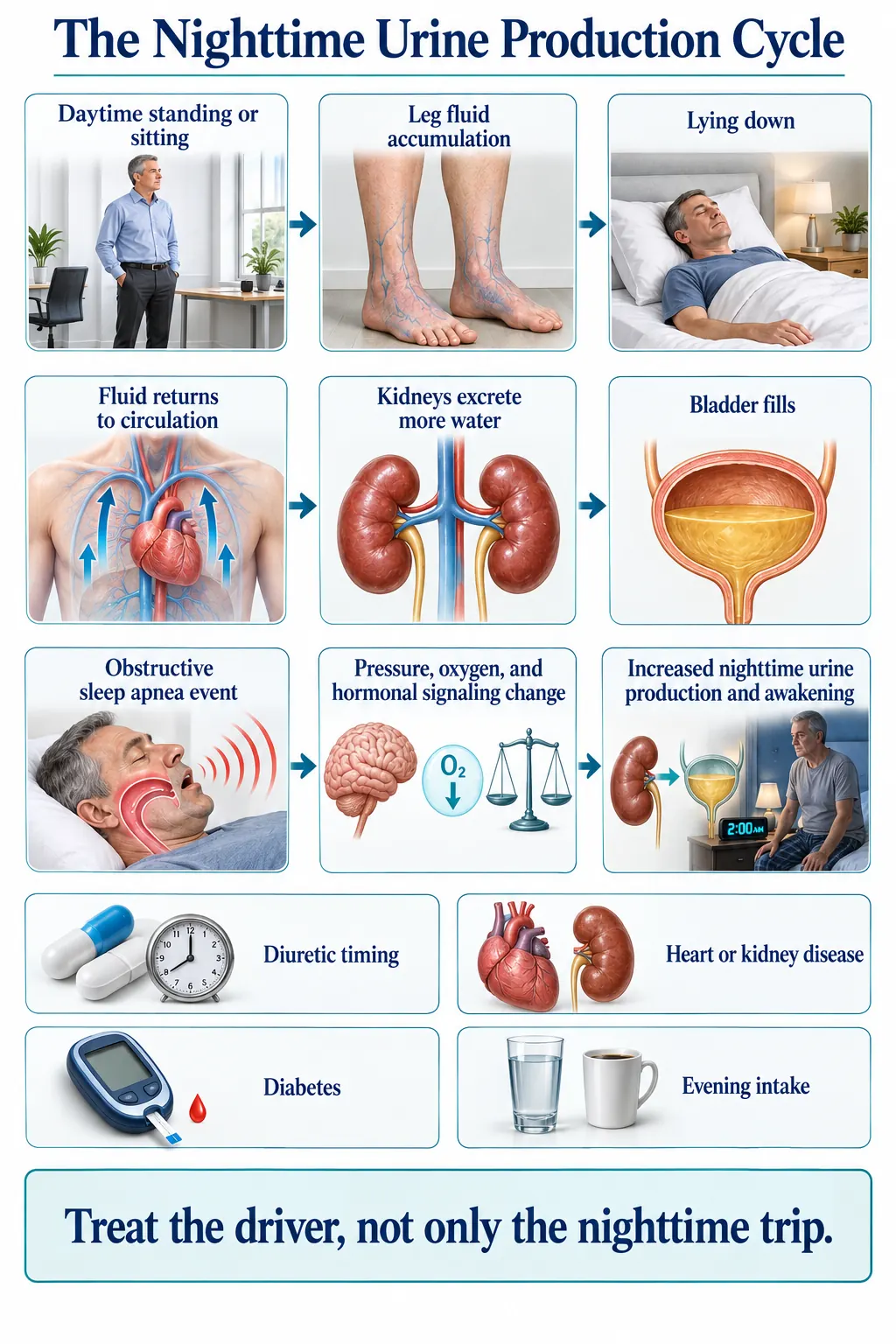
- Fluid that pools in the legs by day returns to the circulation when you lie down, and the kidneys turn it into urine.
- Sleep apnea can increase nighttime urine production and fragment sleep.
- Simply stopping drinks after dinner may not help if the real driver is sleep apnea, swelling, diabetes or incomplete emptying.
- Nocturia and poor sleep can reinforce each other.
Did your bladder wake you, or did you wake first?
For many people, the worst part of nighttime urination is not the trips. It is the exhaustion: never getting a full night’s sleep, poor concentration, less exercise, irritability. Most assume the prostate or bladder is waking them. That conclusion is understandable, and often incomplete. The first question is what woke you first.
You may wake because of pain, a snoring partner, brief pauses in breathing from sleep apnea, reflux, anxiety, noise, temperature, insomnia or the lighter sleep that often comes with age. Once awake, you notice urine in your bladder and empty it because you are already up. The next morning, it feels as though the bladder woke you. It may have been part of the event without causing it, and that distinction changes the evaluation.
Night changes your physiology
Hormones, blood pressure, fluid distribution, kidney function, sleep and bladder sensation all shift at night. A healthy body usually makes less urine during sleep so you can rest for several hours. When that adaptation is lost, the bladder may simply be responding to more urine. It is doing exactly what it should. The question becomes why.
The four main mechanisms
- The kidneys make too much urine at night (called nocturnal polyuria). You wake several times and pass large volumes each time.
- The bladder cannot comfortably store urine. Voids are smaller, urgency is often prominent, and daytime frequency is common.
- The bladder never empties completely. It starts the night partly full, so it fills sooner.
- You wake for another reason and urinate because you are awake.
The number of trips starts the conversation. The volume tells more. Large, nearly full-bladder voids point toward nighttime production. A few ounces each time points toward storage, irritation, incomplete emptying or broken sleep.
The hidden story in the legs
During the day, gravity lets fluid collect in the lower legs; many people notice mild ankle swelling by evening. When you lie down, that fluid returns to the circulation. The kidneys receive more blood flow, remove the extra water, the bladder fills and you wake. The bladder is reporting a circulation event that began hours earlier. That is why a urologist asks about ankle swelling, long periods of sitting, heart and kidney function, exercise, leg elevation and when you take your medications.
Sleep apnea, diabetes and medication timing
When breathing repeatedly stops during sleep, pressure, oxygen and hormone signals change, and those changes can increase nighttime urine. Some people with nocturia are not waking because of an overactive bladder; sleep apnea is disrupting their sleep and raising urine output at the same time. Treating the sleep disorder can improve nighttime urination without treating the bladder at all.
When blood glucose is high enough, glucose spills into the urine and water follows. You make more urine, feel thirsty, drink more, and the cycle continues. Nocturia can be an early clue to worsening glucose control.
A medication can be correct and still be taken at an inconvenient time. A diuretic taken late in the day can shift its effect into the night. The answer is not to stop an important medicine on your own, but to review dose and timing with the clinician who prescribed it.
The frequency-volume diary
Over two or three days, record drinks, the time and approximate volume of each void, bedtime, wake time, nighttime trips, urgency and leakage. The diary shows whether nighttime production is disproportionately high, whether voids are large or small, and whether the pattern differs from what you remember. It turns a vague complaint into measurable physiology.
A typical evaluation includes your history, a medication review, an examination, a urinalysis and a post-void residual. Blood tests may check for diabetes, kidney disease, heart disease or electrolyte problems. A uroflow test helps when the stream is weak; ultrasound can look at the kidneys, bladder and residual urine.
Treatment must follow the mechanism
If leg fluid is the driver, treatment may include leg elevation, compression when appropriate, exercise, medication review and evaluation of heart or kidney disease. If sleep apnea is present, sleep treatment becomes central. If diabetes is contributing, glucose control matters. If evening drinking is heavy, timing can be adjusted. If the bladder stores poorly, bladder-directed therapy may help. If emptying is incomplete, the outlet and bladder function need attention. If another sleep problem is the true trigger, the bladder may not need primary treatment at all.
Nocturia and poor sleep can feed each other: broken sleep brings fatigue and inactivity, which can worsen metabolic and vascular health and fluid shifts, which bring more nighttime urine. Breaking the loop at the right point, whether sleep, fluids, swelling, the bladder or metabolism, is the goal.
Treatment can take weeks, but a fall can happen tonight. Motion-activated lighting, a clear path to the bathroom, secure footwear and, when appropriate, a stable bedside urinal or commode protect you while the cause is being addressed.
Before your visit
Notice whether each nighttime void is large or small and whether the bladder wakes you or you wake first. Look for ankle swelling, review when you take your medications, and ask your partner about snoring or pauses in your breathing. Note thirst, weight change, daytime fatigue and whether the same symptoms happen during the day.
Questions to ask your urologist
- Am I making too much urine at night, or is this a storage problem?
- Is my bladder emptying completely?
- Would a frequency-volume diary help clarify my pattern?
- Could sleep apnea, leg swelling, diabetes or the timing of my medications be contributing?
- How does the proposed treatment connect to the suspected cause, and what should improve first?