Key points
- BPH is not prostate cancer, and urinary symptoms do not prove cancer is present.
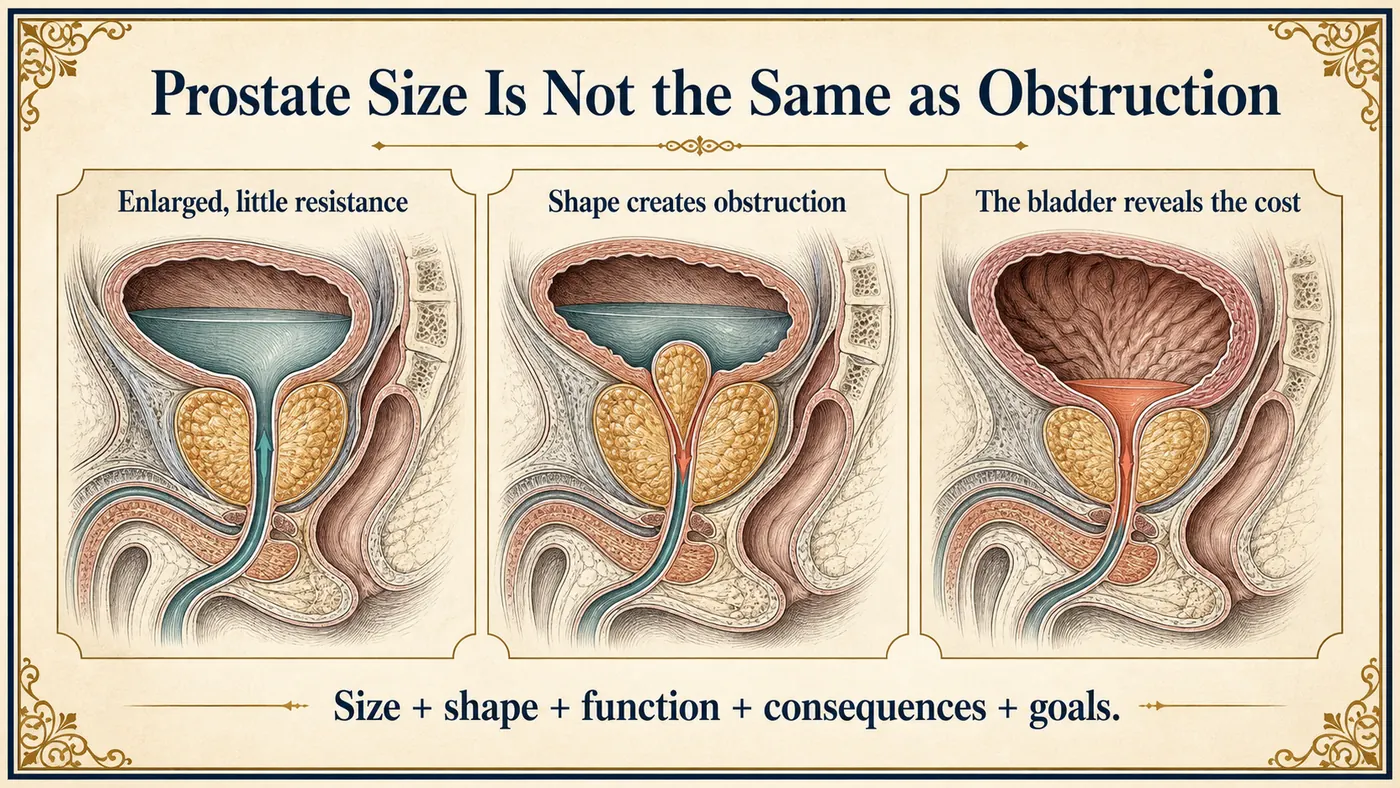
- A large prostate may cause little trouble; a smaller one may obstruct severely.
- Bother and medical risk are different: a large residual, infections, stones or kidney effects can matter even with few symptoms.
- Alpha blockers work in days; 5-alpha-reductase inhibitors shrink selected glands over months and lower PSA.
- Procedures are not ranked from modern to old or minor to major; the best one fits your anatomy and goals.
- Prostate artery embolization is an option for selected men, planned together by the interventional radiologist and urologist.
Size is anatomy; obstruction is physiology
Benign prostatic hyperplasia, or BPH, is noncancerous growth within the prostate. Because the prostate surrounds the urethra just below the bladder, growth can narrow or distort the outlet. But the gland does not grow like a uniform ring. Its shape, the direction of growth, how much protrudes into the bladder, the stiffness of the tissue and the bladder’s response all shape your symptoms. One man may have a large prostate, a strong stream and no complications. Another, with only moderate enlargement, may strain, retain urine and develop bladder changes from years of resistance.
BPH is not prostate cancer, and urinary symptoms do not prove cancer is present. The two can coexist because both become more common with age, so an evaluation may include cancer-risk assessment without treating every weak stream as a cancer symptom.
The bladder carries the workload
Early on, the bladder muscle may contract harder and keep a reasonable stream. Over time the wall may thicken, sensitivity may increase, and urgency or nighttime urination may appear. In some men the muscle eventually weakens, and the same resistance that once caused urgency leads to incomplete emptying and retention.
A good evaluation asks how much symptoms interfere with life, whether the stream has changed, whether you strain and whether you feel empty. It reviews medications, diabetes, constipation, sleep, fluids, prior procedures, sexual priorities and any infection, stones, blood or retention. Tests may include a urinalysis, a post-void residual, uroflow and ultrasound of prostate volume and the bladder and kidneys. Cystoscopy and pressure-flow urodynamics are used when their answers will change treatment.
Bother and risk are different
You may be very bothered but medically safe, or barely bothered while carrying a large residual volume, recurrent infections, bladder stones or kidney effects. A man with mild findings but major disruption may reasonably choose treatment for quality of life; a man with few symptoms but high-risk retention may need treatment to protect his organs. Progression is not inevitable. Before treatment, record a baseline (nighttime trips, stream, residual, urgency, sexual function) so you can tell later whether it helped.
Watching and medication
Not everyone with BPH needs treatment. Mild, uncomplicated symptoms that do not bother you may be watched. Adjusting fluid timing, constipation, bladder irritants and medication effects can help, but cannot reverse fixed obstruction.
- Alpha blockers relax smooth muscle at the prostate and bladder outlet and can improve flow within days. They do not substantially shrink the gland. Dizziness, low blood pressure, fatigue, nasal congestion and ejaculation changes vary. Tell your eye surgeon about current or past use before cataract surgery.
- 5-alpha-reductase inhibitors act on the hormonal pathway that supports prostate growth. In suitably enlarged glands they reduce volume over months and lower the risk of retention or future surgery. Effects on libido, erections, ejaculation, breasts and mood should be discussed in advance. They also lower PSA, so PSA must be interpreted with that in mind.
- Combination therapy offers earlier relief and lower progression risk for selected men, but combines both drugs’ side effects.
- Daily tadalafil may improve urinary symptoms and erections in some men, but is not safe with nitrates and requires cardiovascular screening.
- Bladder-directed medications may help persistent urgency, but only after confirming you empty safely.
For every medication, know the target symptom, how soon it should work, the main side effects and when to reassess. No medication should become permanent through inertia.
Choosing a procedure
First, confirm that obstruction is driving the symptoms. A prostate procedure widens an outlet; it cannot fix excess nighttime urine, untreated sleep apnea, a weak bladder muscle or a pelvic floor that will not relax.
Prostate artery embolization (PAE) is an option for selected men with benign prostate enlargement. An interventional radiologist guides a catheter through an artery and delivers particles that reduce blood flow to part of the prostate, with selection coordinated with your urologist. The discussion covers contrast and radiation exposure, your arterial anatomy, possible effects outside the intended target and the chance of needing further treatment.
Other minimally invasive options retract or remodel tissue, or use heat to ablate it; they may allow office treatment, less anesthesia and a better chance of preserving ejaculation in selected anatomies, with possible delayed improvement, temporary catheters or retreatment. Tissue-removing procedures, including transurethral resection, laser vaporization or enucleation and waterjet resection, can give strong, durable flow improvement but differ in anesthesia, catheter time, bleeding and ejaculation effects. Very large glands may need enucleation or simple prostatectomy.
Consider four time horizons: the procedure, recovery, urination months later and the chance of another treatment years later. Ask separately about erections and ejaculation; “sexual side effects” is too vague for informed consent. Ask how often your physician performs the procedure, and what other specialists might offer. A recommendation is incomplete if reasonable alternatives are left out because the current clinician does not perform them.
Questions to ask your urologist
- Is my prostate actually obstructing urine flow, and how is my bladder responding?
- Which complications would make definitive treatment more important for me?
- What is this medication meant to change, how soon, and when will we decide whether to continue?
- Which procedures, including prostate artery embolization, fit my exact anatomy?
- How do they compare for durability, recovery, catheter time, erections and ejaculation?
- How often do you perform the procedure you recommend, and what would another specialist offer?