Key points
- Confirm that obstruction is driving the symptoms before choosing any procedure.
- The same procedure can be excellent for one gland shape and unpredictable for another.
- Prostatic artery embolization is another option for selected men with benign prostate enlargement, with selection coordinated with the urologist.
- Think in four time horizons: the procedure, recovery, urination months later and the chance of retreatment years later.
- Erections and ejaculation are different functions; “sexual side effects” is too vague for informed consent.
- A recommendation is incomplete if reasonable alternatives are left out because the clinician does not perform them.
The best procedure fits the anatomy and the goal
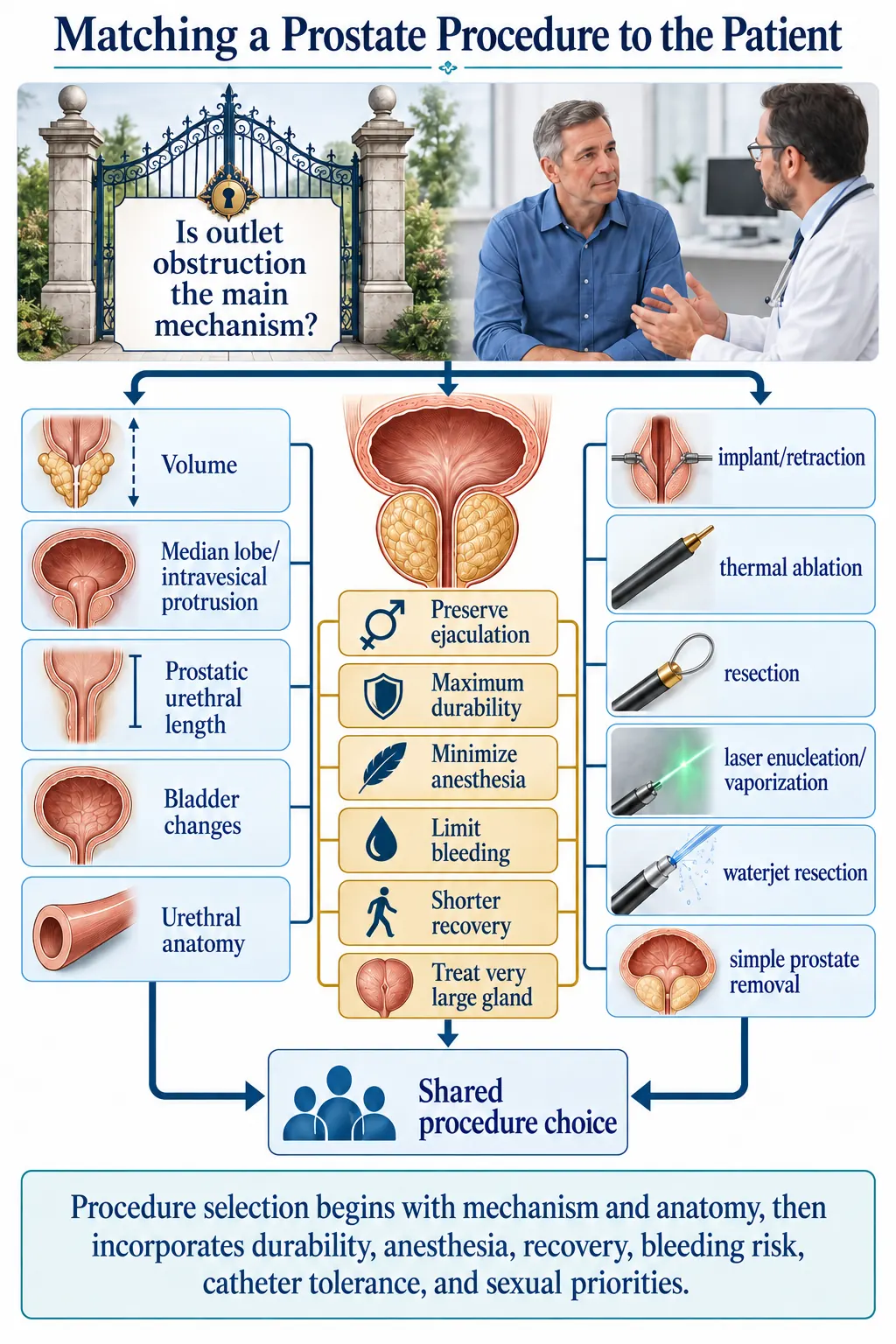
Prostate procedures are not arranged from modern to old or minor to major. They are tools with different strengths, limitations, recovery patterns and sexual consequences. One man may research an office procedure for months because it promises a short recovery and preserved ejaculation, only to learn that his gland shape makes a durable result with that technique less predictable. Another man with similar symptoms but a different gland shape may be an excellent candidate. The procedure has not changed. The match between patient and procedure has.
First, confirm the target
A prostate procedure can widen an outlet. It cannot correct excessive nighttime urine production, untreated sleep apnea, a weak bladder muscle or a pelvic floor that will not relax. When the mechanism is uncertain, more measurement may prevent a technically successful operation that leaves your main symptom unchanged. Caution is warranted when a procedure is recommended without measuring emptying, defining the anatomy or asking about sexual goals.
What anatomy decides
Prostate volume, a middle lobe protruding into the bladder, the length of the prostatic urethra, changes in the bladder and the condition of the urethra all affect which procedures are technically suitable. Bleeding risk and blood thinners, infection risk, how well you tolerate anesthesia, prostate cancer workup, strictures, bladder stones, kidney effects and prior pelvic procedures can narrow the list further.
The main families of procedures
- Retracting or remodeling procedures open the channel without removing large amounts of tissue. Thermal ablation uses heat to treat tissue that shrinks over time. These may allow office treatment, less anesthesia or a better chance of preserving ejaculation in selected anatomies, with possible delayed improvement, temporary catheter use, retreatment and limited suitability for some gland shapes or sizes.
- Resection removes obstructing tissue from inside the urethral channel. Transurethral resection has a long history, and bipolar energy and other refinements have changed fluid and bleeding considerations.
- Laser vaporization removes tissue with controlled energy, and laser enucleation separates the obstructing tissue more completely. These can give strong, durable flow improvement, but anesthesia, temporary irritation, catheter time, bleeding and ejaculation effects differ.
- Waterjet resection uses image guidance and automated tissue removal to create a planned channel. It may suit a broad range of anatomies, though availability, anesthesia, bleeding management and operator experience matter.
- Very large glands may be treated by endoscopic enucleation or, in selected cases, simple prostatectomy by open, laparoscopic or robotic surgery. “Simple” means removing the obstructing inner portion rather than the whole prostate for cancer; it does not mean the operation is trivial.
Prostatic artery embolization
Prostatic artery embolization is another option for selected men with benign prostate enlargement. An interventional radiologist guides a catheter through an artery and delivers particles to reduce blood flow to part of the prostate. Selection should be coordinated with the urologist. The discussion includes contrast and radiation exposure, your arterial anatomy, possible injury outside the intended target and the chance of needing further treatment. As with every option, symptom improvement and relief of obstruction are not identical across procedures.
Four time horizons
It is natural to focus on the first few days. Instead, consider four horizons: the procedure itself, the recovery period, the quality of urination months later and the probability of needing another treatment years later. A less invasive option may be right even if retreatment is more likely. A more extensive tissue-removing operation may be better when durability or severe obstruction dominates. Your values decide how those tradeoffs are weighted.
Durability and recovery need definitions
“Which lasts longest?” is a good question, but lasting can mean the channel stays open, symptoms stay improved, no medication is needed later, or no retreatment is required. A procedure can give meaningful relief for years and still have a higher retreatment rate than a more tissue-removing one. That makes durability one tradeoff, not a verdict. Likewise, “minimally invasive” does not guarantee a symptom-free week. Temporary burning, urgency, blood in the urine, frequency, catheter use and fluctuating flow may occur while swelling settles. Recovery is better described as a sequence than as a marketing adjective.
Sexual outcomes, named separately
Retrograde or markedly reduced forward ejaculation is common after many tissue-removing procedures, while several selected minimally invasive approaches are designed to preserve it more often. A procedure may affect erections and ejaculation differently, so ask about each.
The practical details matter
Before treatment, you should know where it will happen, what anesthesia to expect, whether a catheter is likely and who removes it, how retention will be handled, when blood thinners can restart and which symptoms need urgent contact. Outcomes depend on selection, technique, the system around the procedure and follow-up, so ask how often your physician performs the procedure and what another specialist might offer.
The procedure is not the final test
Follow-up asks whether flow improved, residual urine fell, urgency is settling and nighttime urination changed as predicted, and whether ejaculation, continence or erections changed. A procedure treats resistance; the bladder brings its own history and strength. If the main symptom persists despite an open outlet, the response may reveal a second mechanism that obstruction had been masking.
Questions to ask your urologist
- Is obstruction really the main cause of my symptoms, and how was that measured?
- Which procedures fit my exact anatomy, and which do not?
- How do the options compare for durability, retreatment, recovery and catheter time?
- How might each option affect my erections and my ejaculation, separately?
- How often do you perform the procedure you recommend, and what might another specialist offer?
- Which symptoms may not improve, and what is the next step if the result is incomplete?