Key points
- Frequency is how often you go; urgency is the sudden, hard-to-defer quality of the urge.
- Overactive bladder is diagnosed only after other relevant causes have been considered.
- A post-void residual matters because urgency medications can be inappropriate when emptying is already poor.
- Generic advice to “do Kegels” is not always right; some people need pelvic-floor relaxation and coordination instead.
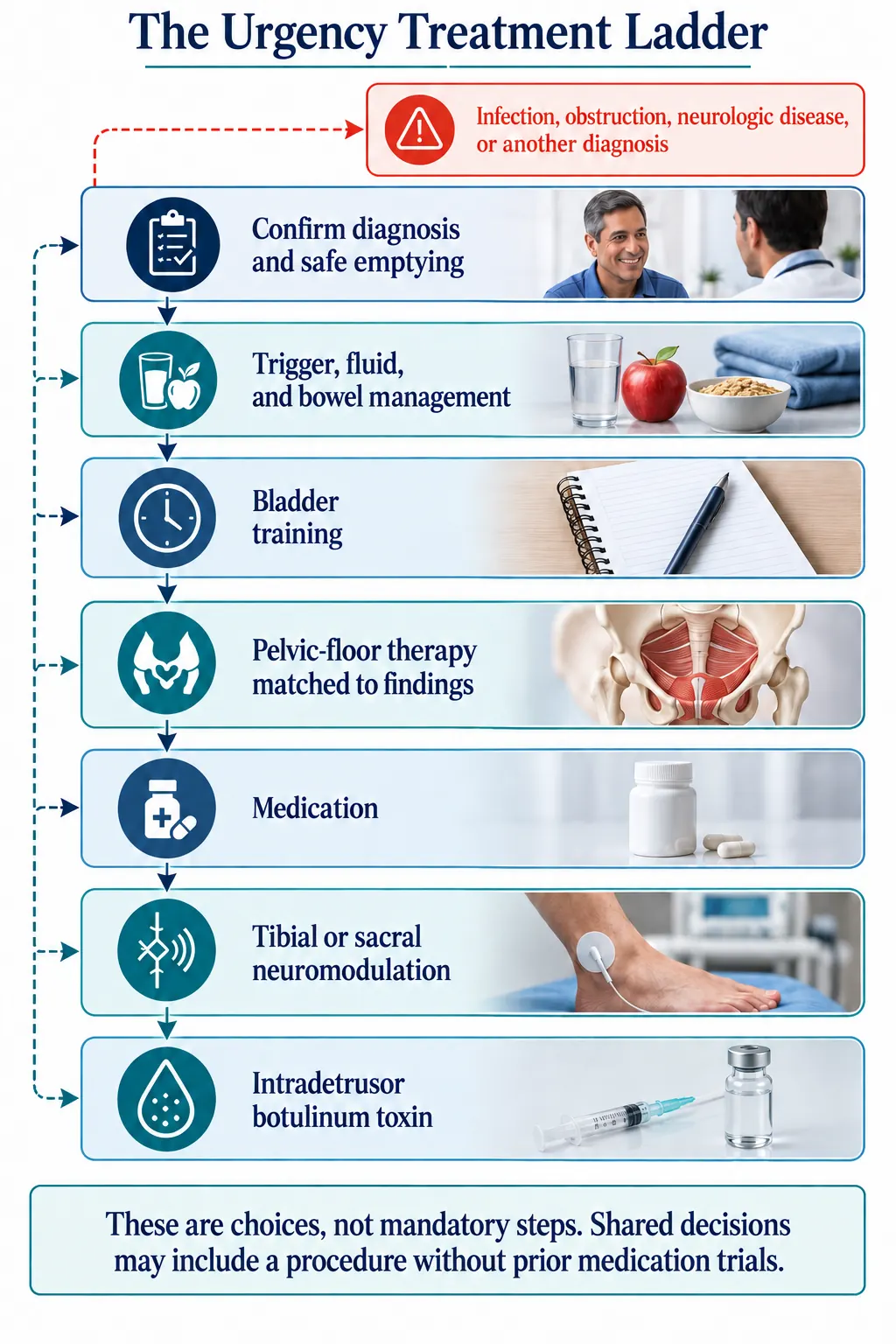
- The treatment ladder explains choices; it is not a compulsory order, and a procedure can be discussed without trying everything else first.
- Success means living normally again, not a perfectly silent bladder.
When your bladder suddenly takes control
Urgency is not simply needing to urinate. It is the sudden feeling that waiting may no longer be possible. Many people who leak on the way to the bathroom believe their bladder has become weak. Urgency rarely means that. More often the bladder is too active, or the signaling system is too sensitive. Those are different problems.
Frequency and urgency are not the same. Frequency describes how often you urinate. Urgency describes the quality of the sensation. You can urinate often without urgency because your kidneys are making a lot of urine, or urinate a normal number of times but feel sudden, overwhelming urges. They often travel together, but the distinction changes the evaluation.
The smoke-detector model
A normal smoke detector stays quiet while dinner cooks and sounds only when enough smoke reaches it. Now imagine one that screams every time someone makes toast. The alarm is real; the threshold has become too sensitive. Urgency often behaves the same way. The bladder is not necessarily full, but the sensory system sends an exaggerated message earlier than it should.
The bladder is both a storage organ and a sensory organ. As it fills, signals travel through the spinal cord to the brain, which weighs them against the setting and access to a restroom. Normally the urge builds gradually and can be put off. With urgency, the message may be amplified or the bladder muscle may contract before you are ready. That is why the urge seems to come from nowhere. It is not imagined. The question is why the signaling changed.
Not every strong urge is overactive bladder
Overactive bladder is a clinical syndrome: urgency, usually with frequency and nighttime urination, with or without urgency leakage, after other relevant causes have been considered. Infection, bladder stones, tumors, concentrated urine, medications, pelvic-floor dysfunction, neurologic disease, incomplete emptying and prior radiation can all produce the same complaint. The label should follow evaluation, not replace it.
Urgency incontinence is leakage that comes with the sudden urge. It differs from stress incontinence, where coughing, laughing, sneezing, exercise or lifting raises abdominal pressure and causes leakage. Both people say “I leak,” but the mechanism and treatment differ.
How the bladder learns habits
Many people start urinating “just in case” to prevent accidents. Over time, repeated early emptying can lower the bladder’s tolerance for filling. That does not make the symptom psychological; it means the signaling system can learn patterns, including unhelpful ones. The same adaptability can be used in reverse. A sudden urge when you arrive home, step into an elevator, hear running water or put your key in the door is a real, learned association, and it can be retrained.
The first evaluation
The history and examination look for infection, blood, pain, neurologic symptoms, pelvic-floor problems, prolapse, medication effects, bowel issues and signs of incomplete emptying. A urinalysis checks for infection, blood and glucose. A post-void residual, the amount left in the bladder after you void, is important because urgency medications can be inappropriate, or need caution, when emptying is already poor. A bladder diary that records urges, triggers, leakage and drinks can reveal patterns. More advanced testing is kept for atypical symptoms, uncertainty, treatment failure, high residual urine, neurologic disease, bleeding, pain or suspected structural problems.
The treatment ladder
Remove what provokes the bladder. Caffeine, alcohol, large fluid loads, poorly timed diuretics, constipation, concentrated urine and untreated sleep apnea can all worsen urgency. The goal is targeted change, not blanket restriction; drinking too little can concentrate urine and create new problems.
Bladder training and urge suppression. Training gradually extends the time between voids. When an urge hits, pausing instead of rushing, controlled breathing, a pelvic-floor squeeze when appropriate and distraction can let the first wave pass. Rushing strengthens the link between urge and immediate emptying. Training should be progressive, not punishing.
Pelvic-floor physical therapy. The pelvic floor may be weak, overactive or poorly coordinated. Therapy is not just strengthening; some people need relaxation and coordination rather than more contraction.
Medication. Medication can be used alongside behavioral treatment or after it, chosen by your goals rather than a mandatory sequence. Different classes act on different pathways. The choice depends on emptying, memory and thinking, blood pressure, constipation, dry mouth, glaucoma history and other medicines.
Advanced therapies. Percutaneous tibial nerve stimulation influences bladder signaling through a peripheral nerve pathway. Sacral neuromodulation uses an implanted system to adjust bladder-nerve communication. Botulinum toxin (Botox) injections into the bladder reduce involuntary contractions, with counseling about infection and urinary retention risk. Reaching these options does not mean you failed; the bladder needs a different level of treatment. They can also be discussed without first trying everything else.
What success looks like
Success is not necessarily a perfectly silent bladder. It may mean enough warning to reach the restroom, fewer accidents, confidence while traveling, sitting through a meeting or sleeping without panic. Measure progress in function as well as counts: warning time, leakage, sleep, travel, exercise and confidence. If the expected improvement does not come, the next step is to revisit the mechanism, adherence and treatment burden before simply adding another therapy. The real goal is to stop organizing your life around your bladder.
Questions to ask your urologist
- What appears to be causing my urgency, and is my bladder emptying safely?
- Could infection, a medication, constipation or my pelvic floor be contributing?
- Would a bladder diary or pelvic-floor physical therapy help me?
- What is the goal of this medication or procedure, and what should improve first?
- Which options remain if the first treatment is not enough?