Key points
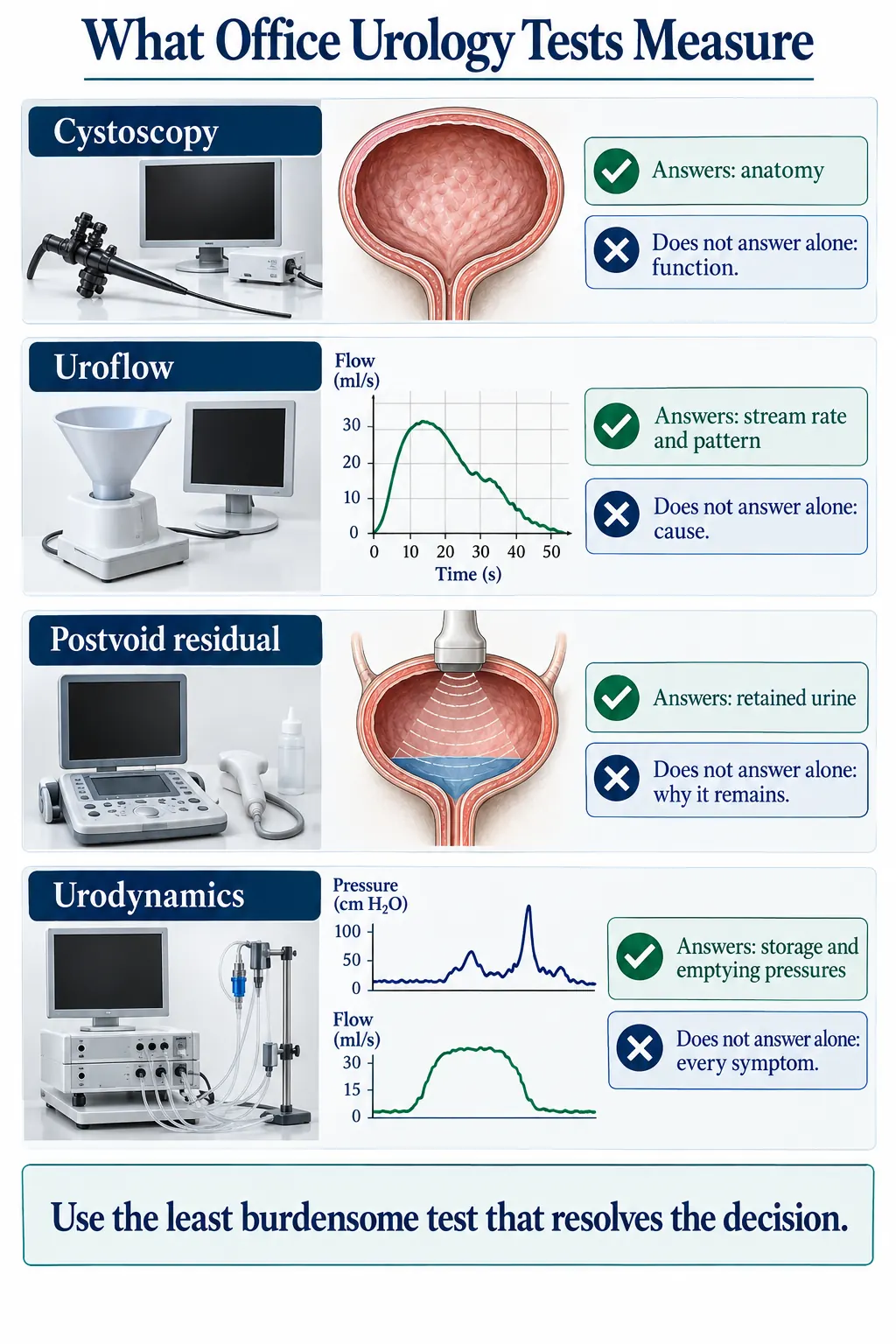
- Cystoscopy shows the urethra, prostate channel and bladder lining, but cannot measure bladder pressure.
- Uroflow depends on voiding an adequate volume; a low flow with a small void may be uninterpretable rather than abnormal.
- A post-void residual varies naturally and shows what remains, not why.
- Urodynamics helps when the diagnosis is uncertain, neurologic disease is present, treatment has failed or a major decision depends on it.
- Many straightforward urinary problems do not need advanced testing at first.
- Do not stop anticoagulants or other medications before a test without specific instructions.
Direct measurement when the story needs another layer
Advanced office testing should clarify uncertainty, reveal anatomy or change treatment, not serve as a ritual before care. Many straightforward overactive bladder or uncomplicated urinary problems do not need advanced testing at first. When a test is proposed, it is reasonable to ask: if the result shows one thing rather than another, how will the plan change? If no one can answer that, the test may not yet be justified.
What each test measures
- Cystoscopy passes a small scope through the urethra to inspect the urethra, the prostate channel, the bladder lining and the openings of the ureters. It may find narrowing, a tumor, a stone, bleeding, foreign material or changes from surgery. It cannot measure every aspect of bladder pressure, or prove that a visible prostate is the cause of all your symptoms.
- Uroflowmetry measures the rate and pattern of your stream. It depends on voiding an adequate volume and on your effort, and it does not identify the cause of a weak stream on its own.
- Post-void residual measures how much urine remains in the bladder after you urinate. It varies naturally from one void to the next and shows what remains, not why it remains.
- Urodynamics recreates bladder filling and emptying while measuring pressure, sensation, leakage and flow. It is useful when the diagnosis is uncertain, neurologic disease is present, prior treatment has failed, or a major decision depends on distinguishing obstruction from a weak bladder contraction or a storage problem.
Consent includes what the test feels like
You may hear the name of an office test but not what actually happens. Before the test, you should know whether a local anesthetic is used, whether a catheter or scope enters the urethra, how long the study usually takes, whether your bladder will be filled, whether you may be asked to cough or strain, and whether urination may burn for a while afterward. Ask what preparation is required, including any infection screening.
Medication instructions should be specific. Anticoagulants, antibiotics, bladder medications and your usual prescriptions should not be stopped through guesswork. You also need an after-test plan: what burning or light bleeding to expect, how much to drink given your medical conditions, whom to call, and which warning signs need prompt attention, such as fever, inability to urinate, heavy bleeding or feeling much worse.
A technically normal test can still be useful
A normal cystoscopy may substantially reduce concern about a visible bladder lesion while leaving pelvic-floor pain or bladder sensitivity unexplained. A low flow rate with a small voided volume may be uninterpretable rather than abnormal. A normal residual on one day does not erase a credible history of intermittent retention. Urodynamics performed in an artificial setting may not reproduce every real-life symptom.
So results always return to your original story. When they agree, confidence increases. When they disagree, a new question arises: was the symptom intermittent, was the test technically adequate, or was the working explanation wrong? The answer is not always to repeat more invasive testing.
Testing burden belongs in the decision
Catheterization, infection risk, discomfort, cost, travel, embarrassment and anxiety are real burdens. They may be justified when a result protects you from the wrong surgery or finds a dangerous condition. They are harder to justify when treatment would stay the same regardless of the result.
The least burdensome adequate test is usually the right next step. “Adequate” matters as much as “least burdensome”: avoiding a necessary test is not patient-centered if the remaining uncertainty exposes you to greater harm later.
What an office test should feel like as a plan
Before cystoscopy or urodynamics, you should be able to explain the question in plain language. During the test, the team should explain what is happening and what sensation to expect. Afterward, you should know what was found, what remains uncertain and how the result changes treatment.
That sequence matters as much as the equipment. A test that ends with no interpretation leaves you with an experience but no decision. A useful test closes the loop: question, measurement, result, next step and a clear plan for warning signs. Once the mechanism and anatomy are clear, the remaining decision is about values: continuing medication, choosing a procedure, accepting surgery or watching safely.
Questions to ask your urologist
- What question will this test answer, and which result would change my treatment?
- What will the test feel like, and how long will it take?
- How should I prepare, and should I change any of my medications beforehand?
- What discomfort is expected afterward, and which symptoms mean I should call or seek urgent care?
- If the result is normal, what will we do next?