Key points
- Pelvic-floor treatment is not always strengthening.
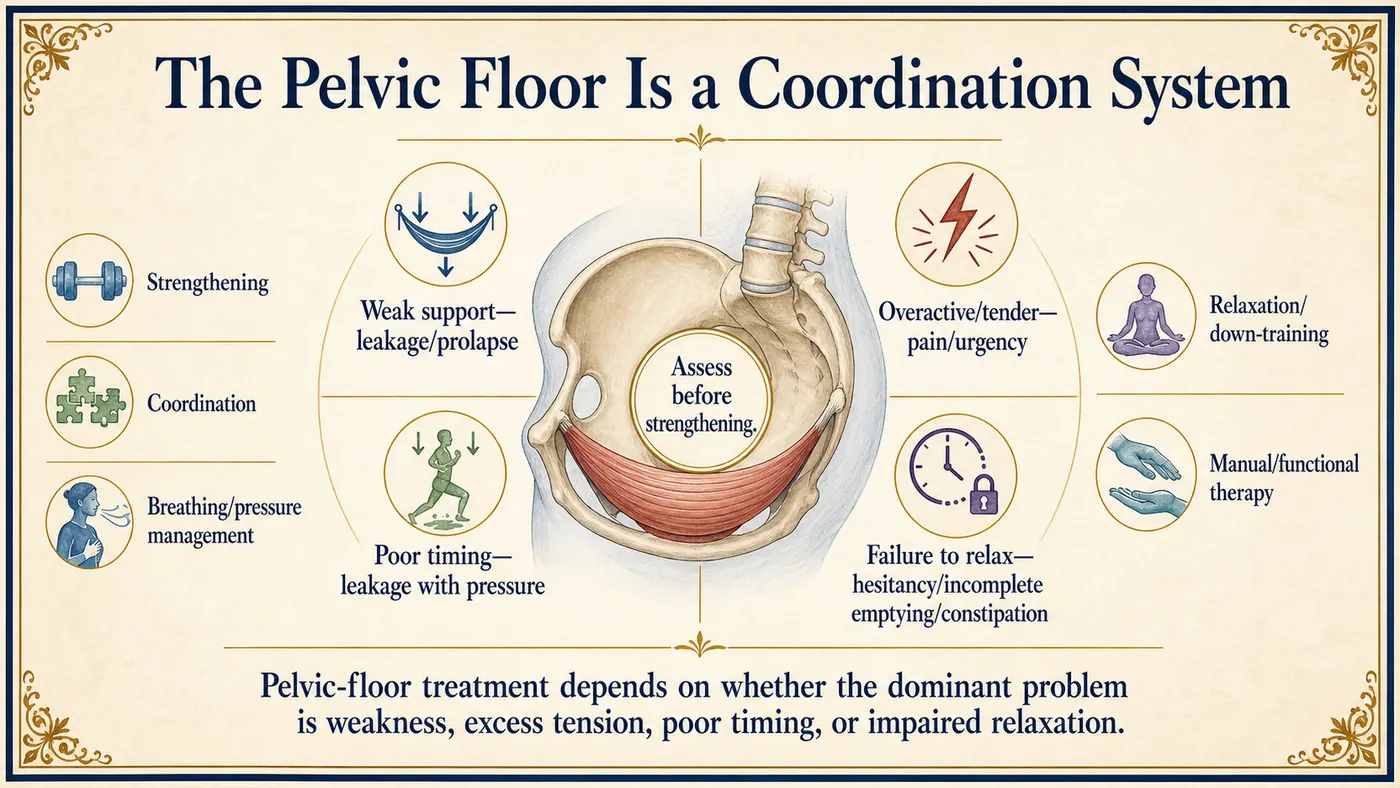
- Weakness can contribute to stress leakage or prolapse; excess tension can contribute to urgency, pain, constipation, painful sex, hesitancy and incomplete emptying.
- A muscle can be both weak and overactive, because constant guarding reduces coordination.
- Aggressive contractions can worsen symptoms in someone whose pelvic floor is already tight and painful.
- Pelvic-floor therapy treats physical function; it does not mean symptoms are imaginary.
- Structural and neurologic causes should be considered before symptoms are attributed to the pelvic floor.
Stronger is not always better
The pelvic floor is a group of muscles at the base of the pelvis. It supports the pelvic organs and coordinates continence, urination, bowel function, sexual function and the management of abdominal pressure. When something goes wrong, the usual advice is “do Kegels.” But a pelvic floor can be weak, overactive, poorly coordinated, painful or unable to relax. “Do Kegels” is not a diagnosis.
Weakness may contribute to leakage with coughing, sneezing or lifting, and to prolapse. Excess tension may contribute to urgency, pelvic pain, constipation, painful intercourse, hesitancy and a feeling of incomplete emptying. A muscle can also be both weak and overactive, because constant guarding reduces effective coordination. And a pelvic floor may have poor timing, failing to tighten at the right moment, or may fail to relax when it should.
How the pelvic floor shows up in urinary symptoms
Urination requires relaxation. The pelvic floor is highly responsive to pain, anxiety, learned habits, prior surgery, trauma and chronic tension. Some people tighten it when they try to urinate, causing hesitancy, an interrupted stream, straining, pelvic discomfort and a sense of incomplete emptying. This happens in men and women. It is a mistake to assume every weak stream in a man is the prostate, or every difficult void in a woman is structural.
The pelvic floor can also cause burning, pressure and urgency that closely resemble a urinary infection, even when the bladder is normal and cultures are negative. In chronic pelvic pain, including pain labeled chronic prostatitis, a tender, guarded pelvic floor is often one of the main drivers: sitting worsens the pain, ejaculation hurts and the stream falters during flares. In urgency, some people need pelvic-floor relaxation and coordination, not more contraction.
For leakage, pelvic-floor training can help women with stress incontinence and men recovering continence after prostate treatment, but it must be taught correctly; endlessly squeezing without relaxation or coordination is not always helpful. Correctly taught therapy can improve strength, timing, pressure management and confidence, and it may be the long-term plan or prepare you for a later procedure.
What a pelvic-floor evaluation looks at
A trained pelvic-floor therapist evaluates breathing, posture, abdominal pressure, tissue mobility, muscle tone, strength, endurance, tenderness and coordination. Coordination is tested during real tasks. A muscle can feel strong during an isolated squeeze yet fail during a cough, a lift, a bowel movement or an attempt to urinate. Breathing and abdominal pressure can either support continence or overwhelm it, which is why a plan based only on squeeze strength may miss the real problem.
Pelvic-floor dysfunction often overlaps with bladder pain, chronic prostatitis symptoms, sexual pain, childbirth injury, surgery, constipation and stress-related guarding. Stress can amplify muscle tension without making the symptoms psychological. Before symptoms are blamed on the pelvic floor, an adequate evaluation should consider structural or neurologic causes.
Therapy matched to the finding
- Strengthening, graded and correctly taught, for weak support and leakage with pressure.
- Relaxation and down-training for overactive, tender muscles that drive pain or urgency.
- Coordination and timing work so the muscles respond at the right moment.
- Breathing and pressure management.
- Manual therapy, including scar and tissue work and pain desensitization.
- Bladder and bowel retraining, including toileting mechanics.
- Biofeedback, movement and a home program.
Rehabilitation connects the examination to daily life. A runner may need pressure control and graded impact. Someone with hesitancy may need relaxation rather than strengthening. Someone with constipation may need toileting mechanics and bowel treatment before bladder symptoms improve.
The most common misconception is that every continence or pelvic symptom reflects weakness. If your pelvic floor is already tight and painful, aggressive contractions may make symptoms worse. An examination turns a generic exercise into targeted rehabilitation.
Progress is more than a stronger squeeze
Useful outcomes include fewer leaks, less pain, easier emptying, better bowel function, more comfortable intercourse, greater exercise tolerance and less fear of movement. Symptoms can fluctuate while you learn, and temporary soreness does not necessarily mean injury, but sustained worsening should prompt a reassessment.
Your home program should be understandable and short enough to actually do. More repetitions are not always better. The goal is a pelvic floor that responds appropriately and then relaxes, not a muscle held in permanent defense.
Questions to ask your urologist
- Is my pelvic floor weak, overactive, poorly coordinated, or a combination?
- Do I need strengthening, relaxation or both?
- Have structural or neurologic causes been considered?
- Should I see a pelvic-floor physical therapist, and what will the therapy include?
- How will we measure progress?