Key points
- Symptoms alone, or bacteria alone, do not define a urinary infection.
- Bacteria in the urine without symptoms is not always an infection that needs antibiotics; pregnancy and certain upcoming procedures are exceptions.
- A contaminated sample can produce a misleading culture and unnecessary medication.
- Infection plus blockage is especially dangerous because antibiotics may not control infected urine trapped behind a stone or obstruction.
- For peri- and postmenopausal women, local vaginal estrogen can reduce recurrence risk when appropriate.
- Current evidence does not support presenting D-mannose as a reliably effective prevention strategy.
When symptoms and evidence must agree
Burning, urgency, frequency, pressure, odor and cloudy urine lead many people to say, “I know I have a UTI.” Sometimes they are right. But vaginal tissue change, urethral inflammation, pelvic-floor tension, stones, bladder pain, concentrated urine and chemical irritation can create the same experience. The opposite also happens: a culture may grow bacteria in someone with no urinary symptoms. That is bacteriuria, and it is not always an infection that needs antibiotics. Pregnancy and certain upcoming urinary procedures are important exceptions.
A urinary infection diagnosis is strongest when three things fit together: compatible new symptoms, signs of inflammation in the urine, and meaningful bacterial evidence on culture. When they disagree, the disagreement is the reason to think again.
The sample is part of the diagnosis
A contaminated sample can produce a misleading result and unnecessary medication. A careful midstream collection, taken before antibiotics when it is safe to wait, makes the culture far more useful. When contamination keeps blurring the picture, a catheter sample may be needed. A negative culture taken after antibiotics tells less than one taken before. Odor alone does not prove infection; urine smell changes with concentration, foods, vitamins and medications. Cloudiness can come from cells, crystals or mucus as well as bacteria.
Who needs more caution
Lower-tract infection usually causes burning, frequency and urgency. Fever, chills, flank pain, vomiting, confusion or general decline raise concern for kidney infection or sepsis. Infection plus blockage is especially dangerous, because antibiotics may not control infected urine trapped behind a stone, stricture or prostate obstruction. Men, pregnant women, and people with catheters, weakened immunity, significant kidney disease, urinary reconstruction, stones, retention or a recent procedure do not fit the simplest pathway, and their evaluation and treatment differ.
Treatment should match you, the organism, the site, resistance, allergies, kidney function, pregnancy status and how sick you are. Antibiotics should be used for the shortest effective course, not recycled from a prior episode. If symptoms persist after the culture shows the bacteria have cleared, the next step is often a new look at the diagnosis rather than a longer course.
Why infections keep coming back
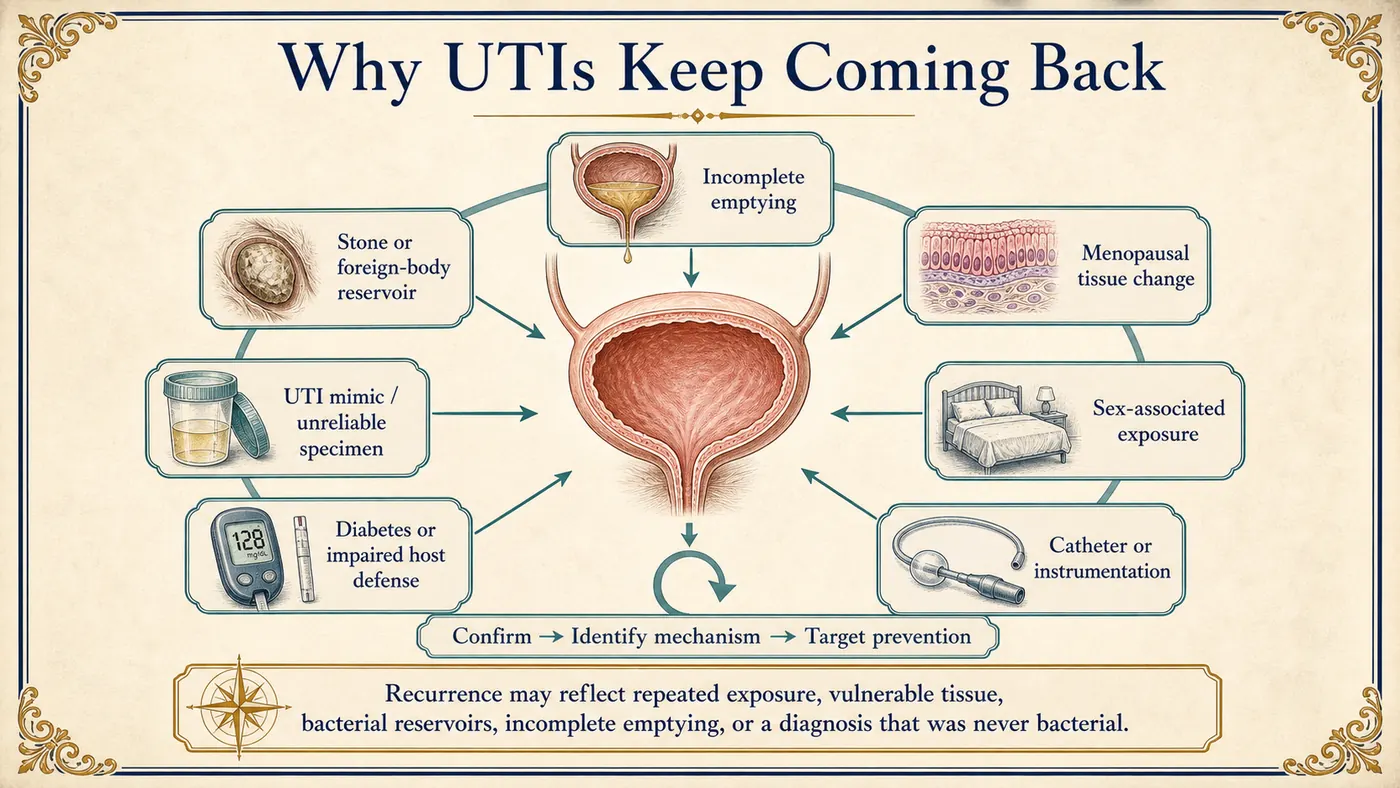
After the second or third infection, the question changes from “Which antibiotic?” to “Why does the urinary tract keep giving bacteria an opportunity?” Start by reconstructing the evidence. Which episodes had real symptoms? Was there inflammation? What grew, and was it the same organism each time? Did symptoms clear between episodes? Were some “recurrences” actually lingering irritation after an infection had cleared?
Reinfection generally means a new episode after the last one resolved. Relapse suggests the same organism returned from a hiding place such as a stone, the prostate, a bladder that does not empty fully or a foreign body.
In women, sexual activity, spermicide, menopause-related tissue change, incomplete emptying, prolapse, stones, diabetes and prior urinary procedures may contribute. In men, recurrence more often prompts a look for obstruction, residual urine, stones, urethral narrowing, catheter exposure or bacterial prostatitis.
Not everyone needs scans or cystoscopy
An otherwise healthy woman with well-documented bladder infections that clear appropriately does not always need a CT scan or cystoscopy; broad testing finds little and can add radiation, cost, incidental findings and anxiety. A closer look is justified when the pattern is unusual: blood that persists after infection, stones, poor emptying, prior reconstruction, an unusual organism, rapid relapse with the same organism, kidney involvement or failure of appropriate treatment.
Building a prevention plan
Prevention begins by confirming that the recurring events are infections. Then the plan targets your contributors: low fluid intake, delayed voiding, spermicide, constipation, vaginal tissue health, incomplete emptying or stones. Hygiene and sexual activity should not be blamed without evidence.
- Local vaginal estrogen can improve the tissue environment and reduce recurrence risk for peri- and postmenopausal women when appropriate. It is different from systemic hormone therapy.
- Cranberry products may offer a modest benefit for some, though content varies.
- Methenamine hippurate is a non-antibiotic option for selected patients.
- More water helps when your usual intake is low; forcing extra fluid when you are already well hydrated is not a universal answer.
- Preventive antibiotics, continuous for a set period or tied to a predictable trigger, remain useful for selected patients once the diagnosis is documented. Self-start therapy lets a reliable patient begin a prearranged regimen while still getting cultures.
Current evidence does not support presenting D-mannose as a reliably effective prevention strategy, and probiotics are hard to recommend broadly because products and evidence vary.
Measuring success
Success is not only a full year without infection. Fewer episodes, longer gaps, fewer antibiotic days and more confidence all count. Keep a one-page record of each suspected infection: date, symptoms, urine results, organism, antibiotics that work, treatment and outcome. If “UTIs” continue despite prevention, the diagnosis deserves to be reopened.
Questions to ask your urologist
- Do my symptoms, urinalysis and culture tell a consistent story, or could contamination explain the result?
- Which of my episodes were confirmed infections?
- Does my pattern point toward exposure, vulnerable tissue, poor emptying or a reservoir of bacteria?
- Would vaginal estrogen, methenamine, cranberry or a preventive antibiotic fit my situation?
- If symptoms continue after the bacteria clear, what diagnosis should we consider next?