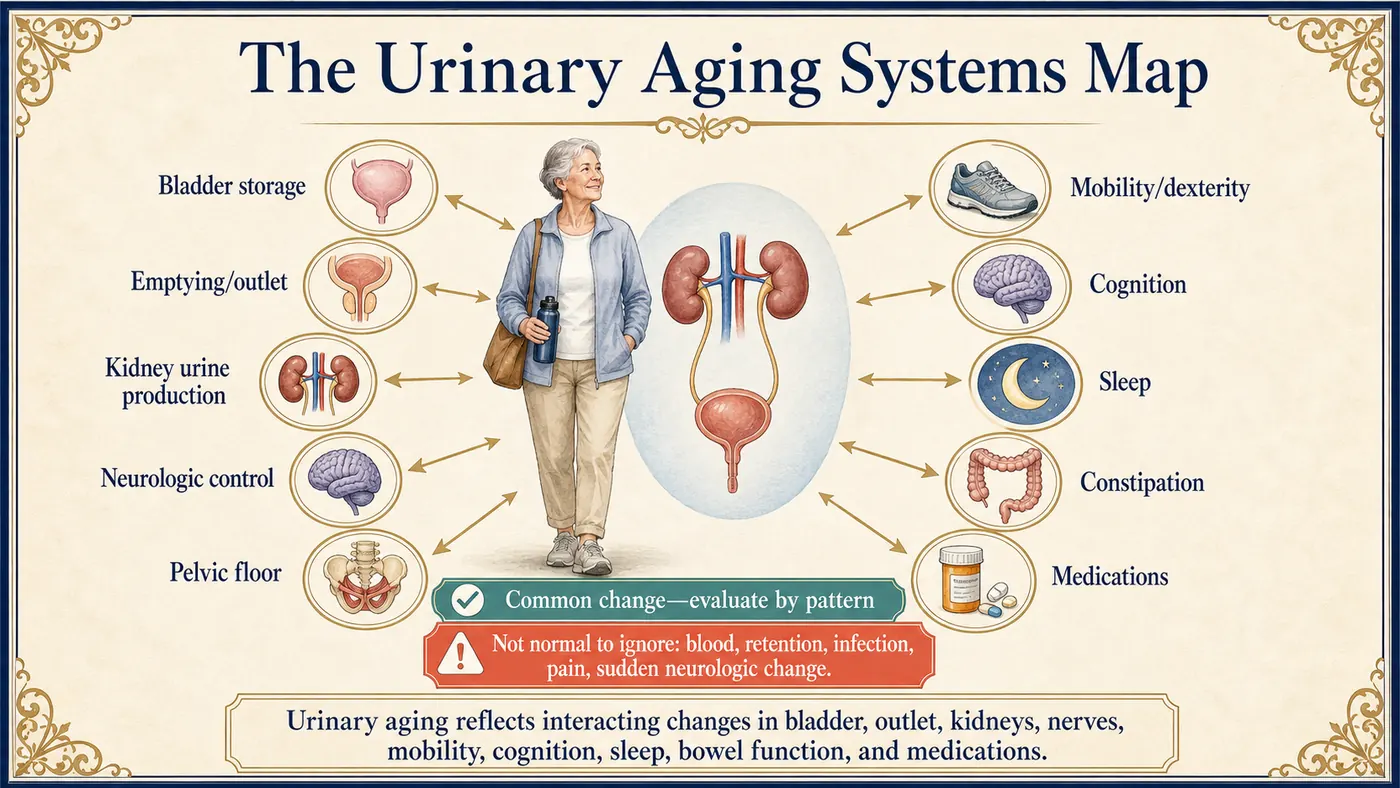
Key points
- The useful question is not whether a symptom is normal for your age, but which function changed and whether it can be reversed or treated.
- An older adult may leak from urgency, weak support, retention, limited mobility, sedating medication or cognitive change, or several at once.
- Adding a bladder drug without checking emptying and function can make things worse.
- Medications should be reviewed as a system; fewer interacting drugs may be safer than another prescription.
- A plan that depends on unavailable caregiver support is not truly a plan.
- Independence and intimacy are legitimate medical outcomes.
Aging changes risk; it does not explain every symptom
Urinary change is not always normal aging. Aging may alter bladder capacity, sensation, muscle strength, prostate anatomy, the kidneys’ ability to concentrate urine, sleep, mobility and medication use. But it does not produce one uniform decline. Storage, emptying, urine production, mobility, cognition, medications, pelvic support, prostate resistance and kidney reserve can each change at a different speed.
So the useful question is not whether a symptom is normal for your age. It is which function changed and whether that change is reversible, treatable or important to monitor. Once you name it, decide whether the priority is reversal, reducing risk, adapting, or simply watching.
One symptom, several causes
An older adult may leak because of urgency, weak support, retention, impaired mobility, a sedating medication, cognitive change, or all of these at once. Adding a bladder drug without checking emptying and function may worsen the situation. Likewise, a catheter can solve a drainage problem while creating infection, injury and loss of independence if it becomes permanent without reassessment.
Preservation begins early. Progressive obstruction should be assessed and treated when symptoms or risks justify it, though relieving an obstruction does not guarantee that a weakened bladder will recover. Reducing falls and nighttime hazards, maintaining strength, controlling constipation, simplifying medications and evaluating neurologic change all help. Continence strategies should be ones the patient or caregiver can actually manage.
Separate the bladder from the ability to reach the toilet
Continence is an interaction between bladder control and the environment. One person may store urine adequately yet leak because arthritis, weakness, cognitive change, poor lighting or complicated clothing delays getting to the toilet. Another may reach the toilet easily but have urgency from infection, medication or overactive bladder. Treating both with the same bladder medication ignores the mechanism.
A functional assessment asks whether you can recognize the urge, stand, walk, transfer, remove clothing and complete hygiene safely. These questions are not outside urology. They determine whether a medical plan can work.
Review medications as a system
- Diuretics affect urine volume and timing.
- Sedatives can impair waking and balance.
- Antihistamines and decongestants may worsen emptying.
- Constipating medications can amplify bladder and pelvic-floor symptoms.
- Bladder-calming drugs can cause dry mouth, constipation, cognitive burden or retention in susceptible people.
The answer is not to stop necessary treatment indiscriminately. It is to review the combined effects, timing and alternatives with your clinicians, and to focus on the function most at risk. The safest urinary regimen may be the one with fewer interacting medications rather than another prescription layered on top.
Caregiver feasibility is a clinical issue
Timed voiding, intermittent catheterization, pads, external devices and overnight plans all need hands, time, memory, supplies and consent. A strategy that depends on unavailable caregiver support is not truly a plan. The burden on both the patient and the caregiver should be discussed before discharge from a hospital or before a long-term device is chosen.
Preserving independence may mean restoring continence. It may also mean simplifying care enough that a person can remain safely at home. Both are legitimate outcomes.
Track what matters, in order of priority
A useful assessment produces a short list of priorities, not a pile of unrelated tests. Near-term threats come first: infected obstruction, retention affecting the kidneys, significant bleeding, a concerning mass or rapid functional decline. Next come risks that can be modified, such as blood pressure, diabetes, smoking, sleep apnea, recurrent stones, medication burden and loss of strength. Each measurement should have an owner and a schedule, and should stop when it no longer changes care.
Independence and intimacy are medical outcomes
Quality of life is not the consolation prize after treatment; it is one of the outcomes being treated. Continence, reliable emptying, intimacy, sleep, mobility, independence, caregiver burden and treatment workload should be named before a plan is chosen. It can help to ask which outcome you could not accept, such as permanent catheter dependence, severe leakage or losing independent living.
Intimacy includes touch, closeness, desire, communication and adapted sexual practices, not erection or penetration alone, and counseling and rehabilitation can protect connection even when function changes. A plan that was right at sixty may become burdensome at eighty-five, so devices and medications should be reviewed periodically rather than continued simply because they once solved a problem. The goal is not a “young” bladder, but safe drainage, acceptable storage, continence compatible with your goals and the greatest possible independence.
Questions to ask your urologist
- Which urinary function has changed, and is the change reversible, dangerous or something I can adapt to?
- Am I emptying my bladder well enough to use a bladder medication safely?
- Could any of my medications be contributing, and can the regimen be simplified?
- How can treatment preserve my independence with the least burden?
- Can my caregiver and I realistically sustain this plan?
- When should we review whether a device or medication is still needed?