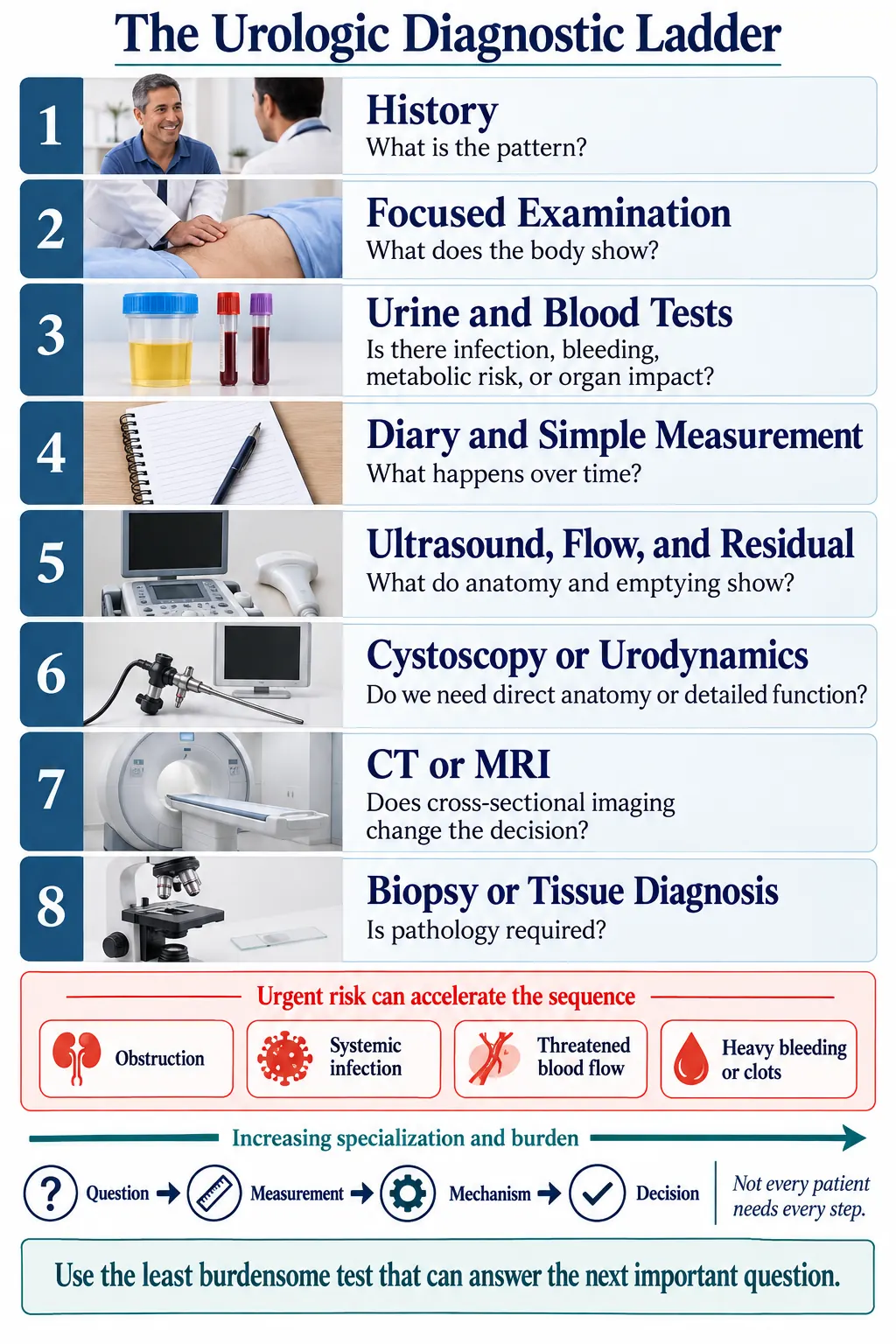
Key points
- Ask what uncertainty a test will reduce and how each possible result would change the plan.
- The history is the first diagnostic instrument, and contradictions in it are often the key clue.
- A diary, a residual measurement and a flow test can answer questions no scanner can.
- Not every patient needs every rung; an emergency can skip ahead, and prior testing can shorten the climb.
- A normal result means the test did not find what it measures; it does not erase the symptom.
- A failed treatment is diagnostic information, and the ladder should always end in a decision.
Begin with the question, not the machine
Many people imagine that modern diagnosis begins with a scan and that ordering every test is the safest approach. It is understandable, and usually unhelpful. Every test has a burden: discomfort, radiation, contrast, cost, time, or the discovery of an incidental finding that has nothing to do with your symptom. If we look hard enough at almost anyone, we find a small cyst, a slightly abnormal value or an age-related change. That finding can trigger another test, another consultation and occasionally a procedure no one would have considered if the first question had been better defined.
Each test sees one part of the problem. A CT can show an enlarged prostate but cannot prove it is causing a weak stream. A PSA contributes to cancer-risk assessment but does not measure obstruction. A cystoscopy shows the inside of the bladder but not how strongly the bladder muscle contracts. So the better starting point is not “Which test should I order?” but “What do we still need to know?”
The rungs of the ladder
- History: what is the pattern? When a symptom began, how fast, what makes it better or worse and what changed around the same time. A weak stream that declined over ten years and one that began yesterday after surgery raise completely different questions.
- Focused examination: what does the body show? A full bladder, leg swelling, a genital mass, prolapse, pelvic-floor tenderness or a neurologic finding can redirect the whole workup. The exam should test a hypothesis, not follow a ritual.
- Urine and blood: is there infection, bleeding, metabolic risk or organ effect? A urinalysis can change a consultation within minutes. A culture asks a narrower question. Kidney function, glucose, blood count, PSA or testosterone are chosen for a reason, and trends often matter more than one value.
- Diaries and simple measurement: what happens over time? A measuring cup, a clock and a short record can separate excess urine production from poor storage. Memory is unreliable for repeated events.
- Ultrasound, flow and residual: what do anatomy and emptying show? Ultrasound answers focused questions without radiation. The post-void residual shows whether urine stayed behind, though not always why. A flow study measures the complaint instead of relying on an adjective.
- Cystoscopy or urodynamics: is direct anatomy or detailed function needed? Cystoscopy shows anatomy; urodynamics measures function. They answer different questions and earn their place when simpler findings do not line up or the answer will change an invasive treatment.
- CT or MRI: does cross-sectional imaging change the decision? The most detailed image is not always the most useful. The best study is the one whose answer changes the decision with an acceptable burden.
- Biopsy: is pathology required? Imaging estimates; pathology examines tissue. A suspicious finding does not make biopsy automatic, and fear alone should not prevent biopsy when tissue is needed for a consequential decision.
Contradictions are clues
You may believe your prostate is causing nighttime urination, yet a diary shows most of your urine is made overnight. You may have been treated repeatedly for infection despite cultures that do not support it. You may feel you never empty while a bladder scan keeps showing a low residual. Contradictions are not inconveniences. They are often what prevents treatment of the wrong mechanism.
The ladder is not rigid
An emergency accelerates the sequence. Sudden severe testicular pain may need immediate examination and surgery. Fever with a blocked kidney may need urgent drainage before the full workup. Clot retention may need the bladder drained before the bleeding source is investigated. The ladder can also be shorter: well-documented prior tests may not need repeating, and a low-risk first episode may need only a history, examination and limited testing. Recurrent, previously treated or contradictory symptoms may reasonably justify a deeper workup because the simple explanation has already failed.
A normal test is not the same as no problem
A normal culture does not explain persistent burning. A normal cystoscopy does not exclude overactive bladder or pelvic-floor dysfunction. A normal ultrasound does not prove the bladder contracts normally. A flow study done after a tiny void may not be interpretable. When symptoms persist despite reassuring studies, the right response is not dismissal. It is to ask which mechanism has not yet been measured.
A failed treatment is information
If an antibiotic repeatedly fails, infection becomes less convincing. If a bladder medication worsens emptying, the outlet deserves another look. If a prostate medication does not help, the problem may not be mainly prostate-driven. Repeating the same treatment without revisiting the mechanism wastes one of the most useful clues you have provided.
The ladder must lead to a decision
Testing is not the destination. The workup should end with a clearer choice: observe, adjust behavior or medication, treat infection, improve storage, relieve obstruction, obtain tissue, perform a procedure, refer, monitor a trend or seek another opinion. If the concern is flow, measure flow. If it is emptying, measure the residual. The quality of a workup is not defined by how high it climbs, but by whether it stops when the important questions have been answered.
Questions to ask your urologist
- What question will this test answer, and how could the result change my treatment?
- What are this test’s limitations or blind spots?
- Is there a less burdensome way to get the information we need?
- What are the risks of testing compared with the risks of waiting?
- What will we do if the result is normal but my symptoms continue?