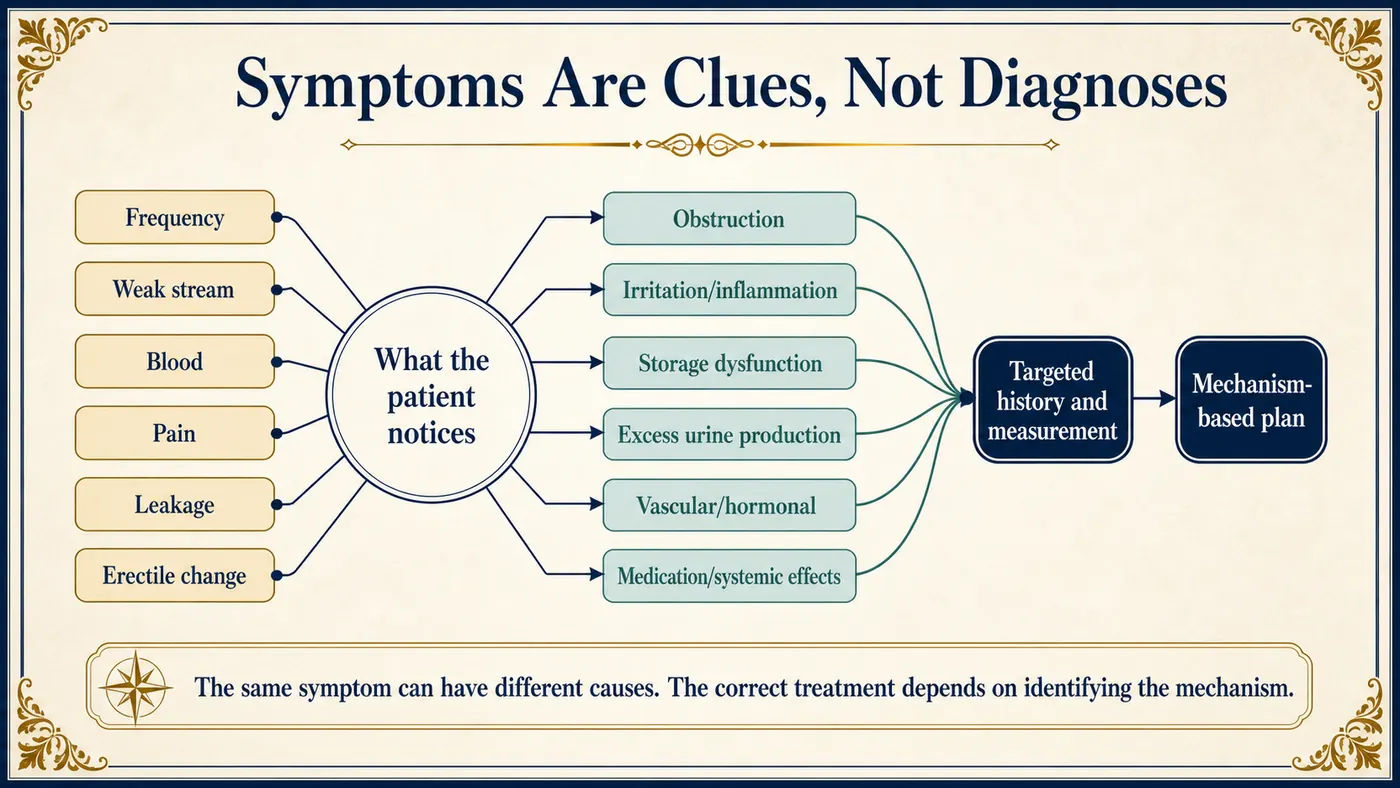
Key points
- One symptom can come from many conditions, and one condition can cause complaints that seem unrelated.
- The organ producing the complaint is not always the organ that explains it.
- Many urinary complaints sort into storage, emptying, urine production or pain.
- The timeline often reveals more than the intensity: why is this happening now?
- A normal test is reassuring only for the question that test was designed to answer.
- Symptom relief and investigation can usually proceed together, as part of a plan.
The symptom is the beginning, not the diagnosis
Your symptom is real even when the first test is normal. But a symptom is almost never the diagnosis. It is the beginning of the investigation. Blood in the urine, for example, does not tell you whether the cause is an infection, a stone, prostate bleeding, kidney disease, injury or a tumor. It tells you that bleeding has entered the urinary tract and deserves an explanation.
Patients naturally reach for a direct explanation. A weak stream becomes “an enlarged prostate.” Urgency becomes “overactive bladder.” Burning becomes “a urinary tract infection.” Erection trouble becomes “low testosterone.” Sometimes that first explanation is right. Often it is only one possibility. A good urologist takes your theory seriously, and then tests it.
The organ that complains may not be the cause
The urinary tract does not work in isolation. Hormones influence urinary and sexual function, blood vessels determine tissue health, nerves coordinate storage and emptying, and the kidneys regulate fluid. Sleep disorders, diabetes, obesity, neurologic disease, heart disease and medications can all produce symptoms that first look “urologic.” That is why a urologist may ask about your blood pressure, blood sugar, snoring and medications before asking more about your prostate.
Waking at night to urinate may come from the prostate or bladder, but it may also come from sleep apnea, diabetes, fluid from the legs returning to the circulation at night, or a diuretic taken late in the day. A decline in erections can be a reason to look more carefully at vascular and metabolic risk. It is not proof of heart disease, but it is worth noticing.
What lies below the surface
Think of an iceberg. Above the water is what you feel: urgency, pain, blood, leakage, a weak stream, a change in sexual function. Beneath it lie anatomy, physiology, risk factors, medication effects, sleep, metabolism, inflammation and disease. “I am urinating too often” does not say whether the bladder stores too little or the kidneys make too much. A diary may show tiny voids; a blood test may reveal uncontrolled diabetes; an ultrasound may show urine left behind. The same complaint can lead in different directions.
Symptoms also rarely occur alone. The most useful clue is often one you did not think was relevant: constipation, a recent antihistamine, back problems, vaginal dryness, snoring or weight gain. At the same time, you can have more than one condition at once. Good diagnostic thinking connects clues without inventing connections.
Four questions behind most decisions
- Is there an emergency? Threats that cannot safely wait come first, before any ideal outpatient workup.
- Is this storage, emptying, production or pain? Storage problems cause urgency, frequency or leakage; emptying problems cause hesitancy, a weak stream or retention; production problems mean the kidneys make too much urine; pain and irritation can mimic the others.
- Is the problem structural, functional, systemic or behavioral? A stone or scar changes anatomy; nerve or muscle problems change how anatomy works; diabetes or a medication starts outside the urinary tract; habits such as “just in case” voiding can intensify symptoms. Often more than one is at work.
- Which test will change what we do? The right test answers the right question at the right time. More tests are not the same as better medicine.
Why is this happening now?
The timeline often reveals more than intensity. A symptom unchanged for ten years differs from one that appeared last week. A slowly weakening stream differs from sudden inability to urinate after surgery or a new medication. Tell your clinician when the symptom began, whether it came on suddenly or gradually, whether it is constant or comes and goes, what makes it better or worse, what else appeared at the same time and what preceded it: a medication, procedure, illness, trip or change in habits.
Several small changes can add up to one important pattern. One nighttime trip becomes two, then three; fatigue becomes “normal aging.” Common with age does not mean irrelevant.
Traps that delay the right diagnosis
Anchoring happens when the first explanation becomes fixed and new information is bent to fit it. Premature closure means stopping too early: an enlarged prostate does not prove the prostate is causing the symptoms. Normal-test reassurance forgets that a normal urinalysis cannot rule out overactive bladder or pelvic-floor problems, and a normal PSA does not evaluate obstruction. Treating the number lets prostate size, a residual or a lab value replace the whole picture. And if a symptom stopped, the problem is not necessarily gone; visible blood that disappears may still need evaluation.
Help the pattern emerge
You do not need to diagnose yourself, but organized observations improve the workup. Bring a complete medication and supplement list, including sleep aids, antihistamines, decongestants and diuretics. For frequency or nighttime urination, a two- or three-day diary of drinks, voiding times and volumes beats a general estimate. Do not tidy the story to make it simpler. Contradictions can be diagnostically useful.
What a good consultation should give you
You should leave knowing what is most likely, what is most important not to miss, and what additional information would change the plan. You should understand why each test is ordered, what can be done now for relief, and which changes need urgent reassessment. Relief matters. So does explanation. The goal is to listen to the symptom, investigate the pattern and treat the cause whenever possible.
Questions to ask your urologist
- What are the leading possible causes of my symptom, and is anything dangerous being excluded?
- Which part of the urinary or sexual system appears to be affected?
- Could one of my medications or another medical condition be contributing?
- What question will each proposed test answer?
- Can my symptoms be treated while the evaluation continues?
- Which changes should send me for urgent care, and when will we reassess?