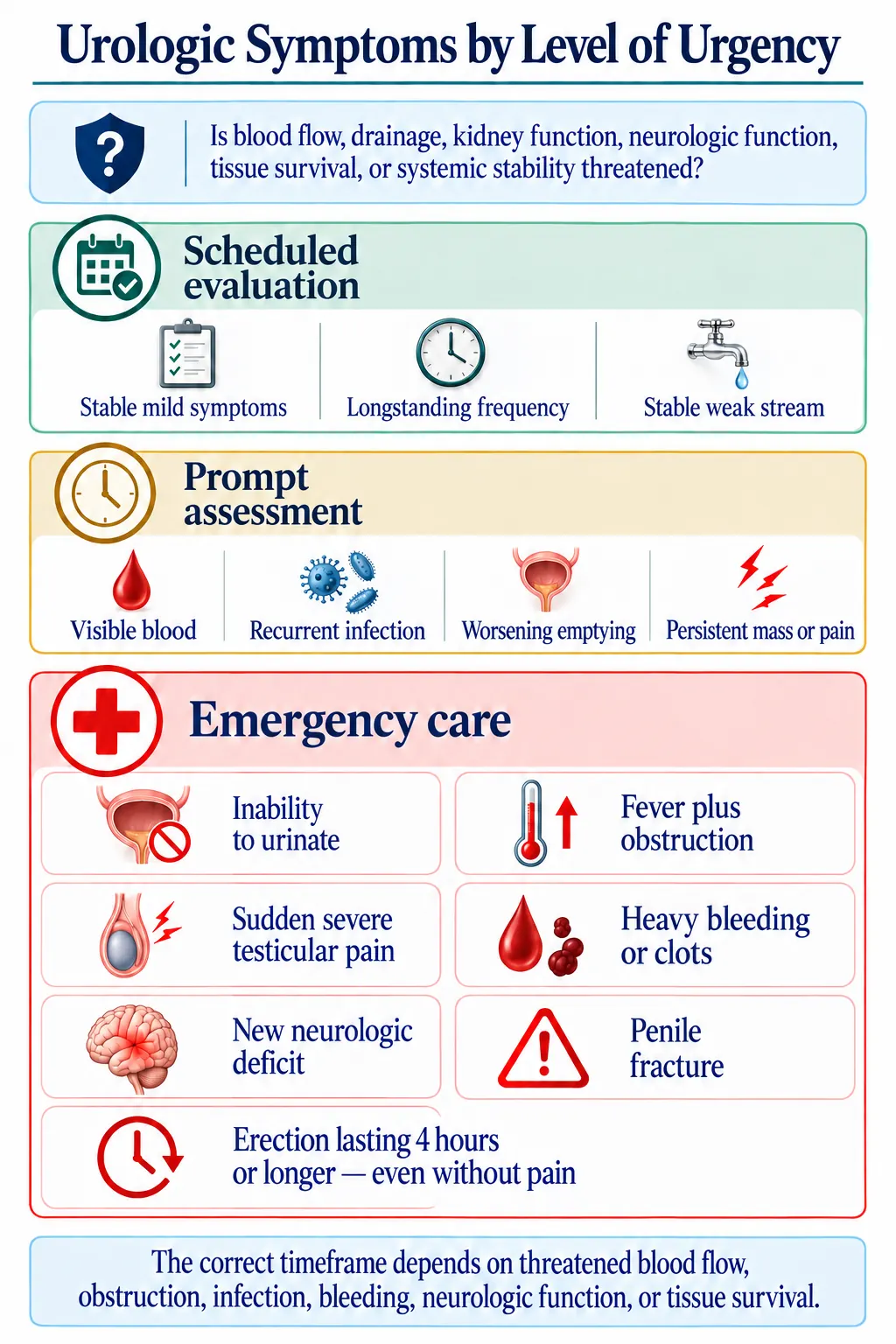
Key points
- Fear and urgency are not the same: severe pain can be stable, and a mild symptom can be dangerous.
- Sudden testicular pain must be treated as possible torsion until proven otherwise.
- Fever with a blocked kidney can become life-threatening and may need drainage, not just antibiotics.
- Sudden inability to urinate and an erection lasting four hours or longer need emergency care, even without pain.
- Visible blood that stops on its own still needs evaluation.
- “Not an emergency” does not mean “not important.”
Fear and urgency are not the same
Most urologic symptoms are not emergencies. The challenge is recognizing the few situations in which delay can cause permanent harm. A symptom can be dramatic and still allow a thoughtful outpatient workup. Another can seem mild and still need immediate treatment. A person with severe kidney-stone pain may be stable enough for outpatient care, while someone with relatively little pain but fever and a blocked kidney may be developing a life-threatening infection.
Urgency is not determined by how frightening a symptom feels. It is determined by what may happen if treatment is delayed. Kidney function can be lost. A testicle can be lost. Bladder function can deteriorate. Infection can enter the bloodstream. Bleeding can block the urinary outlet. Correct timing is part of correct treatment.
Five threats that make time matter
- Threatened blood flow. Testicular torsion and ischemic priapism are the clearest examples; tissue cannot stay healthy without oxygenated blood.
- Threatened drainage. Acute urinary retention and blocked kidneys create pressure and impair urine flow.
- Infection with systemic risk. A bladder infection is different from infection in a blocked kidney or infection with sepsis.
- Threatened tissue. Rapidly progressive soft-tissue infection, such as Fournier gangrene, can destroy tissue quickly.
- Threatened nerve function. New retention or incontinence with leg weakness, saddle numbness or loss of bowel control can signal serious spinal or nerve compression.
Testicular torsion: when hours matter
Torsion occurs when the spermatic cord twists and cuts off blood flow to the testicle. It is most common in adolescents and young men but can happen at other ages. The classic sign is sudden pain on one side of the scrotum, sometimes with nausea or vomiting, and the testicle may sit higher than usual. The earliest phase may not look dramatic, so waiting for swelling is unsafe. Do not wait until morning to see whether it improves: if the cord is twisted, the testicle may be losing its blood supply while you wait. Ultrasound can help when the picture is uncertain, but testing should not create avoidable delay when suspicion is high.
A blocked, infected kidney
When a stone blocks the ureter and bacteria are trapped behind it, antibiotics may not be enough because the infected urine cannot drain. Warning signs include flank pain with fever, chills, persistent vomiting, marked weakness, confusion or looking severely ill. Diabetes, immune suppression, pregnancy, a single kidney, a transplant or advanced age lower the threshold for urgent care. Treatment is not simply stronger pain medication; the kidney may need drainage through a stent or a nephrostomy tube, along with antibiotics.
Acute urinary retention
Sudden inability to pass urine despite a full bladder usually reflects a trigger on top of an already vulnerable system: prostate obstruction, medications such as certain antihistamines and decongestants, anesthesia, constipation, urethral narrowing, infection, clots or neurologic disease. The prostate did not suddenly grow overnight. The immediate priority is drainage with a catheter, which relieves pressure and protects the urinary tract while the cause is investigated. Sudden complete inability to urinate needs immediate assessment, even without pain.
Priapism
An erection lasting four hours or longer needs emergency assessment, even if it is not painful. In ischemic priapism, blood is trapped in the penis and oxygen delivery falls; waiting risks tissue injury, scarring and later erectile dysfunction. It may be associated with erection injections, certain medications, sickle cell disease, blood disorders and recreational drugs. If you use penile injections, have a written plan before the first home dose, and do not combine injections with sildenafil, tadalafil or another erection medication unless your prescriber has deliberately designed that regimen. Embarrassment is one of the most dangerous causes of delay.
Destructive infection, heavy bleeding and sepsis
Fournier gangrene is a rare but life-threatening infection of the genital and perineal tissues. Severe pain, swelling, redness, skin discoloration, foul drainage, fever, or looking much sicker than the skin suggests require emergency hospital care.
Visible blood in the urine does not always need the emergency department. It does when bleeding is heavy, clots block urination, or you feel dizzy, faint, weak, short of breath or have chest discomfort. Blood thinners can increase bleeding but do not explain why it began. A urinary infection needs prompt assessment when fever, shaking chills, flank pain, persistent vomiting, confusion or reduced alertness suggest illness beyond the bladder.
Urgent but not always an emergency
Some problems need prompt contact without an emergency visit: visible blood without clot retention, a new scrotal lump or swelling, worsening stone symptoms without fever, recurrent infections, significant difficulty urinating without complete retention, and persistent fever with urinary symptoms. For recurrent infections, the urgency may be to stop repeating the same treatment and investigate the cause.
Gradual frequency, urgency, nighttime urination, a weak stream, stable erectile dysfunction, chronic pelvic pain and stable leakage generally fit a scheduled office evaluation when they are not rapidly worsening. A symptom can be routine in timing and still important in diagnosis.
Match the setting to the problem
Telemedicine can help with triage and deciding what level of care you need. It cannot untwist a testicle, drain an infected kidney, catheterize a full bladder or reverse priapism. When the situation is unclear and delay could be serious, prompt in-person assessment is safer than reassurance from a checklist.
Questions to ask your urologist
- What is the immediate threat, and is blood flow, drainage, kidney function or tissue at risk?
- Does treatment need to begin now, or is close follow-up safe?
- What will this test answer, and could an infection be trapped behind a blockage?
- Which symptoms should bring me back immediately?
- When and how will the underlying cause be evaluated once the emergency is controlled?