Key points
- A lab flag means a value fell outside a reference range; it is not a diagnosis.
- A poorly collected urine sample can contain skin or vaginal bacteria and cells that obscure the picture.
- When a result conflicts with your symptoms, repeating a clean specimen may be more useful than treating the first report.
- A trend counts only when the measurements are comparable.
- Detection is not explanation: blood, white cells or a low testosterone value start a workup rather than finish it.
- Every result should lead to a clear next decision.
A result answers only the question it was designed to answer
Never read a lab flag as a diagnosis by itself. Abnormal does not always mean dangerous, and normal does not mean that every urologic system is healthy. Ask whether the sample was collected under useful conditions, what the test can and cannot show, whether a trend is reliable and what decision changes because of the result. Repeating a questionable specimen can prevent treatment of noise, such as a course of antibiotics for contamination.
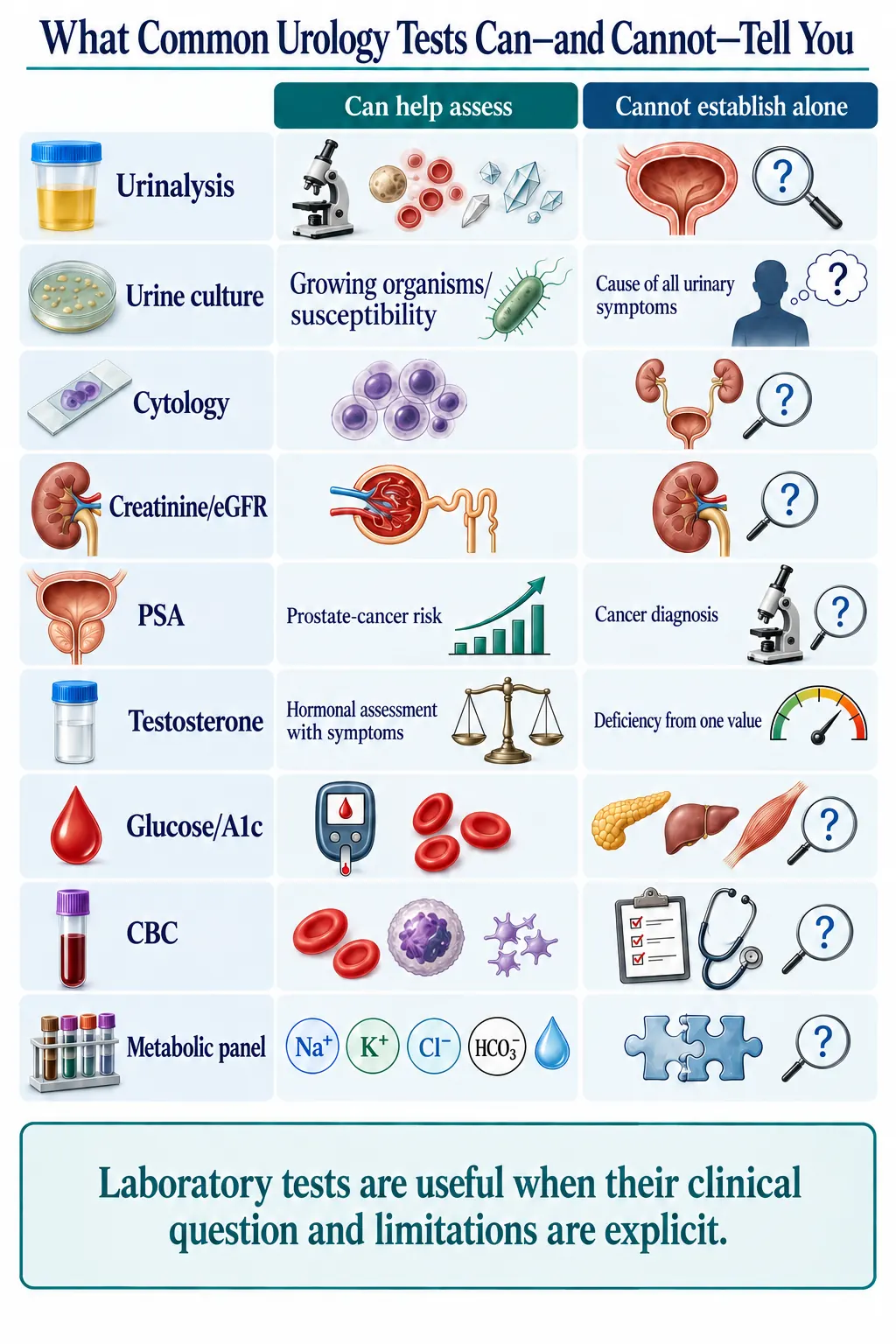
What common tests can and cannot tell you
- Urinalysis is a screening map. Blood may start a workup for hematuria. White cells and nitrites may support infection, but symptoms and a culture still matter. Glucose can reflect metabolic disease. Protein may point toward kidney injury. How concentrated the urine is changes how irritating it feels and how other findings are interpreted.
- Urine culture finds organisms that grow under laboratory conditions and shows which antibiotics they respond to. Collection quality, symptoms, the pattern of growth, prior antibiotics, catheters and recurring organisms determine whether growth means infection, contamination or harmless colonization. A culture cannot by itself explain every urinary symptom.
- Cytology looks for abnormal cells shed into the urine and is used selectively. It does not replace cystoscopy or imaging when those are indicated.
- Creatinine is used to estimate the glomerular filtration rate (eGFR), a measure of how well the kidneys filter.
- PSA informs prostate-cancer risk. It does not provide a tissue diagnosis.
- Testosterone needs proper timing, repetition and matching symptoms. A single low value does not establish deficiency.
- A1c reflects longer-term glucose exposure, while a complete blood count (CBC) can reveal anemia, infection-related changes or treatment complications.
Each test becomes meaningful only as part of a pattern, read alongside your symptoms, your examination and your other results.
The sample begins before the laboratory
Collection conditions can change a result before the machine measures anything. A poorly collected urine sample may contain skin or vaginal bacteria and cells that obscure whether infection is present. Antibiotics taken before a culture may suppress growth. Dehydration concentrates urine. Vigorous exercise, menstruation, a recent procedure, acute illness, urinary retention and medication timing can all affect selected findings.
This does not make laboratory testing unreliable. It means that quality begins with the question, preparation, timing, collection and handling. When a result conflicts sharply with your symptoms, repeating a clean specimen may be more informative than immediately treating the first report as unquestionable truth.
Reference ranges are not diagnostic borders
A lab flag means a value fell outside that laboratory’s reference range. It does not always distinguish harmless variation from disease. On the other hand, a value inside the printed range may still be concerning if it has changed substantially from your own baseline or conflicts with other evidence.
Trends are useful only when the measurements are comparable. Changes in laboratory method, medication, acute illness, hydration and timing should be considered before a small numerical movement is given biological meaning. A repeated abnormality under reliable conditions carries more weight than an isolated surprise. Keeping copies of your past results, with dates and the name of the laboratory, makes these comparisons possible.
Detection is not explanation
White blood cells reveal inflammation but do not identify its cause by themselves. Blood in the urine begins a workup but does not locate the source. A positive culture shows growth but does not prove that bacteria explain chronic symptoms in every group of patients. A low testosterone result does not establish the cause of fatigue. A PSA value does not provide a tissue diagnosis.
The best interpretation finishes two sentences: “This result makes us more or less concerned about…” and “Because of that, the next decision is….” Without the second sentence, testing can become accumulation rather than care.
The one question to ask
When you receive a result, ask: “What question did this test answer, and what decision changes because of it?” That question prevents both panic over incidental abnormalities and false reassurance from a test that never evaluated the system causing your symptoms. Before treatment follows a laboratory finding, confirm what that finding actually represents.
Lab tests measure chemistry and cells. When the question is about anatomy, tissue behavior, blood flow or how an organ works, imaging or office testing may be the better tool.
Questions to ask your urologist
- What question was this test designed to answer?
- Could collection, timing, illness or a medication have affected the result?
- Should the sample be repeated before we act on it?
- How does this result compare with my previous values?
- What decision changes because of this result?