Key points
- ED is not “just aging” or “just in your head.”
- Because penile arteries are small, vascular problems may show up there before elsewhere.
- A morning total testosterone belongs in the ED evaluation; a low result needs confirmation.
- PDE5 inhibitors such as sildenafil and tadalafil must never be combined with nitrates.
- An apparent pill failure may reflect how it was taken; correct use should be checked first.
- An erection lasting four hours or longer needs emergency care, even without pain.
An erection is a whole-body event
Erectile dysfunction can be a sexual problem, a relationship problem, a medication effect, or an early sign of vascular, metabolic, neurologic or hormonal disease. Often it is more than one. A man may want a stronger pill while also carrying a growing waistline, untreated high blood pressure, poor sleep and no recent cardiovascular check. The prescription matters. So does the warning.
An erection needs coordinated blood inflow, restricted outflow, intact nerves, responsive smooth muscle, hormonal support and psychological readiness. A disruption anywhere in that chain can reduce rigidity or staying power. Because the penile arteries are small, vascular problems may become noticeable there before they cause symptoms elsewhere.
Defining the problem
Trouble getting an erection differs from losing it during sex. Difficulty in one situation differs from a steady loss in every setting. Preserved morning erections show that the system can still work under some conditions, but they do not prove the problem is purely psychological. Does the penis become firm and then lose pressure, never become fully rigid, or need more and more stimulation? Desire, orgasm, ejaculation, curvature, pain, fertility plans, medications, substance use and your relationship all belong in the same conversation.
Diabetes, high blood pressure, abnormal cholesterol, smoking, obesity, inactivity, sleep apnea, heart disease, pelvic surgery, radiation, neurologic disease, depression and many medications can contribute. The evaluation includes blood pressure and metabolic risk, a morning total testosterone level and other tests chosen for you. Specialized vascular or nerve testing is used only when it will change treatment.
Psychological factors are not imaginary causes. Performance anxiety triggers a physiology that works against erection, and after one failure, fear of another can become part of the mechanism even when the original trigger was vascular or a medication.
A proportionate heart conversation
ED is associated with vascular risk, but it does not predict an imminent heart attack. The right response is neither dismissal nor panic. It is a review of blood pressure, glucose, cholesterol, smoking, weight, activity, sleep apnea, family history and symptoms with exertion. For someone with chest discomfort, marked breathlessness, fainting or uncertain exercise safety, heart evaluation may need to come before treatment.
The treatment options
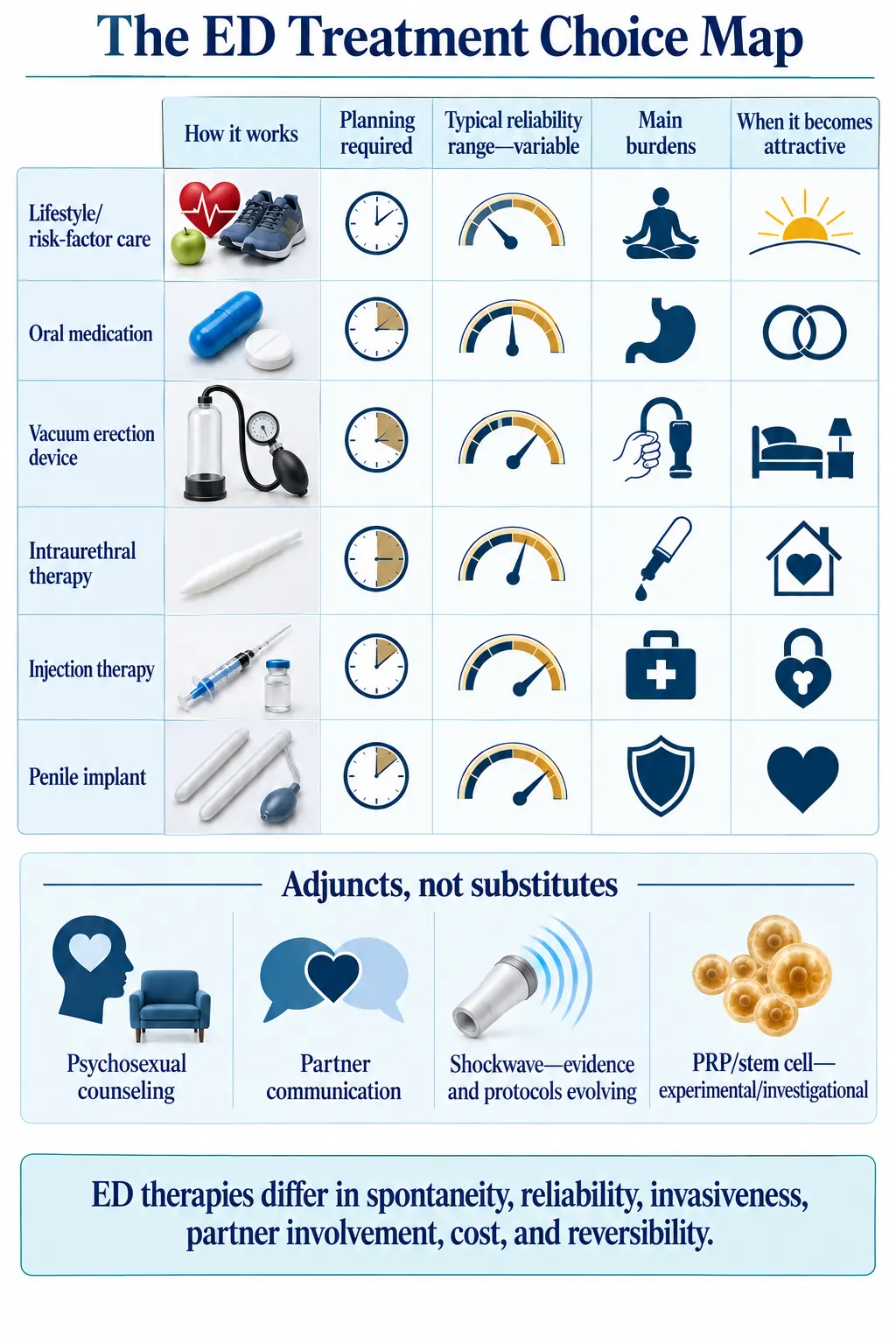
Lifestyle and risk-factor care (exercise, weight loss when appropriate, stopping smoking, treating sleep apnea, controlling diabetes and blood pressure, reviewing medications) supports vascular health and may improve response to other treatments. It should accompany treatment, not delay relief indefinitely.
Oral medication. PDE5 inhibitors such as sildenafil and tadalafil enhance the body’s natural erection pathway; they do not create desire or an automatic erection. They must not be combined with nitrates, and heart status and other medicines need review. Before calling a pill a failure, check how it was used: timing, a heavy meal for drugs where that matters, enough stimulation, alcohol, anxiety and repeated attempts. When it was used correctly and still did not work, that result narrows the options; it does not end them.
Vacuum device. It draws blood into the penis and uses a ring to maintain rigidity. Some couples value its drug-free reliability; others dislike the planning, coolness, bruising or altered ejaculation.
Intraurethral and injection therapy deliver medication more directly. Injections can be highly reliable after careful teaching and dose adjustment. The emergency plan for a prolonged erection must be explained before the first home dose.
Penile implant. Surgery places inflatable or malleable components that provide predictable, on-demand rigidity regardless of pill response. It carries risks of infection, mechanical problems and revision, and it does not restore libido, sensation or natural erectile tissue.
Emerging options. Low-intensity shockwave therapy is still evolving, with variation in devices, protocols and durability. Carefully selected patients have often reported meaningful benefit with little burden in Dr. Shusterman’s practice, but that is clinical observation, not a controlled estimate. Professional recommendations differ: the AUA classifies it as investigational, while the EAU gives a weak recommendation for selected men, particularly with vascular ED. Platelet-rich plasma and stem-cell approaches should not be marketed as established cures.
Success in your own terms
Some men want spontaneity; others want dependable rigidity even if planning is needed. A partner may value communication and predictability. You do not need to fail every option in a fixed order, but you should understand the burden and safety plan of the one you choose. A treatment that stays unopened in a drawer is not a success. Partner involvement should be offered, never required.
Questions to ask your urologist
- Could my erection problem signal vascular, metabolic, hormonal, neurologic or medication-related disease?
- Which baseline tests are appropriate for me?
- Was I using my medication correctly, and should we adjust it before moving on?
- What is the next treatment meant to do, and what side effects or emergencies should I recognize?
- When should we move to another option rather than keep repeating one that isn’t working?