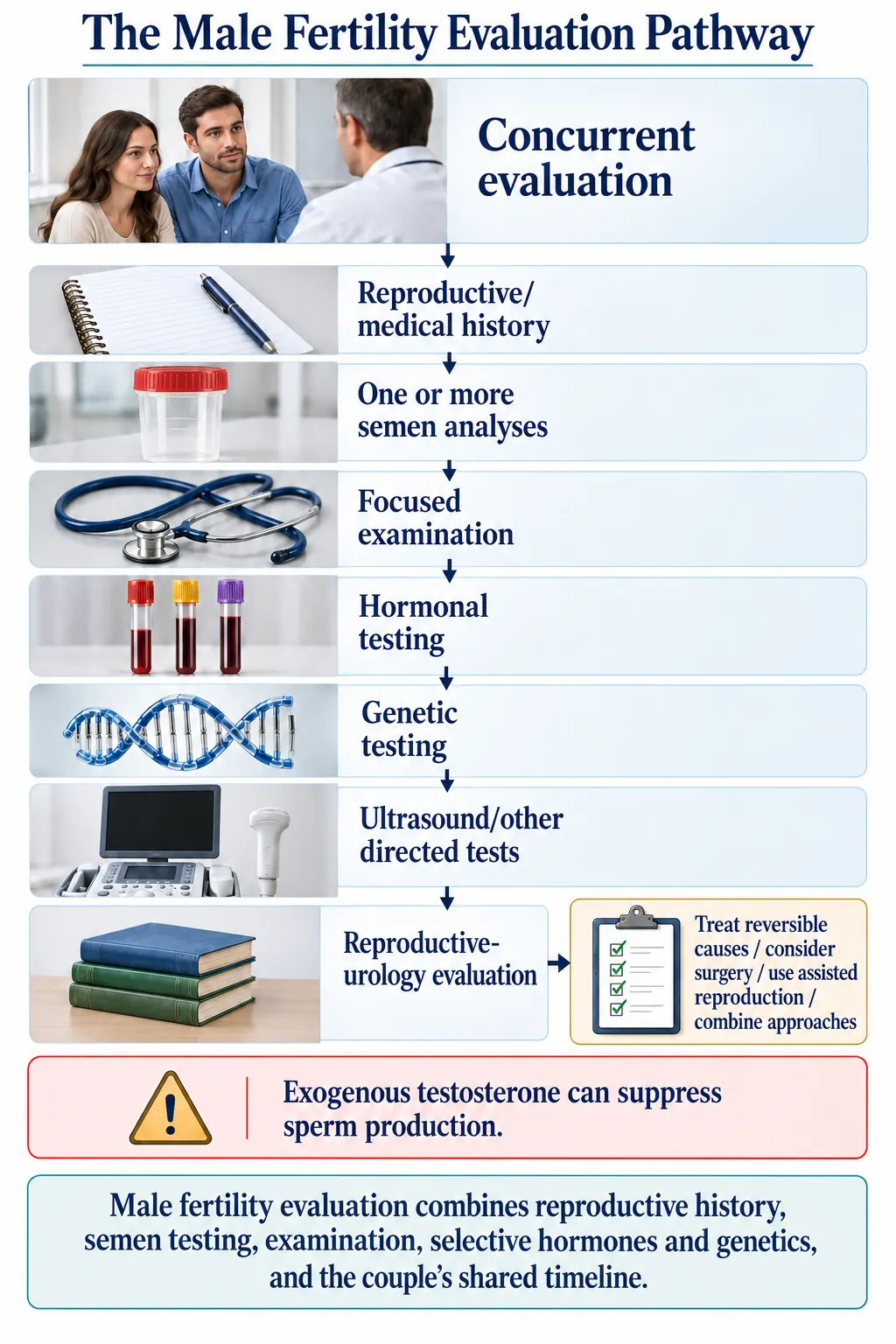
Key points
- Fertility is not only a female issue; a man who feels healthy may still have a significant sperm abnormality.
- A semen analysis is not a pass-fail test, and one abnormal result often needs to be checked again.
- Testosterone is not a fertility treatment; it can dramatically suppress sperm production.
- Hormone tests, genetic tests and ultrasound are used selectively, to answer specific questions.
- Treating a reversible cause, surgery, sperm retrieval and assisted reproduction are not a simple ladder; they may proceed together.
- A severe abnormality can be a signal about a man’s broader health.
Fertility is a couple’s evaluation
Fertility can be impaired even when erections, desire, testosterone and outward health appear normal. A couple may spend a year completing an extensive workup of the female partner while the man, who feels healthy and has no sexual difficulty, never has a semen analysis. When his first test reveals a significant abnormality, the delay has cost time, not because anyone was careless, but because fertility was mistaken for a female issue.
Both partners should be assessed in parallel. Timing may need to speed up when the female partner is older, or when there is a history of an undescended testicle, chemotherapy, pelvic surgery, genetic disease or another known reproductive concern in either partner.
What a semen analysis measures
A semen analysis measures how much semen is present, how many sperm it contains, and how the sperm move and look. It is not a simple pass-fail test. Results vary, and how the sample was collected matters. The same sperm count can lead to different plans for different couples, depending on their history, the female partner’s age and her test results.
The analysis is a snapshot, not a sentence. Illness with fever, the number of days since the last ejaculation, an incomplete collection, laboratory handling and normal biological variability can all change a result. That is why an abnormal analysis is often repeated, and why the report is interpreted as a pattern rather than a verdict on whether a man can ever father a child.
The parts of the test also shape how the whole is read. There may be fewer sperm, but they may still move well. A low semen volume could mean part of the sample was missed, or that semen moved backward into the bladder, a duct is blocked or the glands made less fluid. Sperm shape is another finding to interpret alongside the rest, not a pass-fail verdict on its own.
History, examination and selective testing
Your history includes childhood testicular conditions, puberty, infection, injury, heat or toxin exposure, cancer therapy, surgery, medications, supplements, anabolic steroids, testosterone, sexual frequency, ejaculation, prior pregnancies and family history. Examination may find a change in testicular size, absence of the vas deferens, a varicocele or another anatomical clue.
Hormone testing is selective. Genetic testing becomes important when sperm production is severely impaired or sperm are absent, because a diagnosis may affect your own health, the chance of finding sperm and what could be inherited. Ultrasound is not a universal first test; it answers specific anatomical questions.
Testosterone can suppress sperm production
External testosterone is not a fertility treatment. It can dramatically suppress sperm production. Men who use anabolic steroids or “optimization” regimens may need a coordinated reproductive plan and time for recovery, and that recovery is not always complete or predictable. Discuss any testosterone or steroid use before fertility treatment begins.
The range of options
Some causes can be corrected. A clinically significant varicocele, a blockage, a hormonal abnormality, a medication, an ejaculation disorder or a lifestyle factor may be treatable. Assisted reproductive technologies can bypass other limitations through intrauterine insemination, in vitro fertilization or intracytoplasmic sperm injection. Surgical sperm retrieval may be considered in selected situations where no sperm appear in the ejaculate.
These options are not arranged in a simple ladder. Sometimes correcting a cause and assisted reproduction proceed together. Sometimes sperm banking protects future options while the workup continues.
Time changes the best path
A reversible male factor may be worth treating, but fertility care cannot ignore the female partner’s age, ovarian reserve, tubal status and the couple’s desired family size. A treatment that may improve semen quality over months can be sensible for one couple and an unaffordable delay for another. Reproductive urology and reproductive endocrinology should communicate rather than proceed on separate clocks.
Consider a couple who have tried to conceive for a year. The first semen analysis is abnormal, but the collection was incomplete and followed a recent fever. Repeating the study under better conditions shows whether the finding persists, while the partner’s age, cycle history and evaluation determine how quickly to move. If the second result remains abnormal, the pattern guides the next step: low sperm number, poor movement, absent sperm, a varicocele, a hormone problem or a blockage each lead to a different plan. The goal is a shared timeline, not two separate workups that never meet.
A severe abnormality can be a health signal
Very low sperm production or absent sperm may lead to genetic and hormonal findings that matter beyond conception. Small testicles, a missing vas deferens, prior cancer therapy, a pituitary pattern or a chromosome or gene finding can affect a man’s own health and what may be passed to children. Genetic counseling helps translate that information without turning probability into destiny.
A result, not a judgment
Men may hear an abnormal semen result as a judgment on masculinity, even though fertility and sexual performance are biologically distinct. The result describes sperm production or delivery under particular conditions. It does not define your worth, your virility or a couple’s chance of building a family through all the available paths. Fertility care works best when blame is removed and time is respected.
Questions to ask your urologist
- What do my semen analysis results mean, and should the test be repeated?
- Are there time-sensitive issues for either partner that should change how fast we move?
- Could any medication, supplement or hormone I take be reducing sperm production?
- Do I need an examination, hormone tests, genetic testing or ultrasound, and what would each answer?
- Is there a correctable cause, and should treating it run alongside assisted reproduction?
- How will you coordinate with my partner’s fertility specialist?