Key points
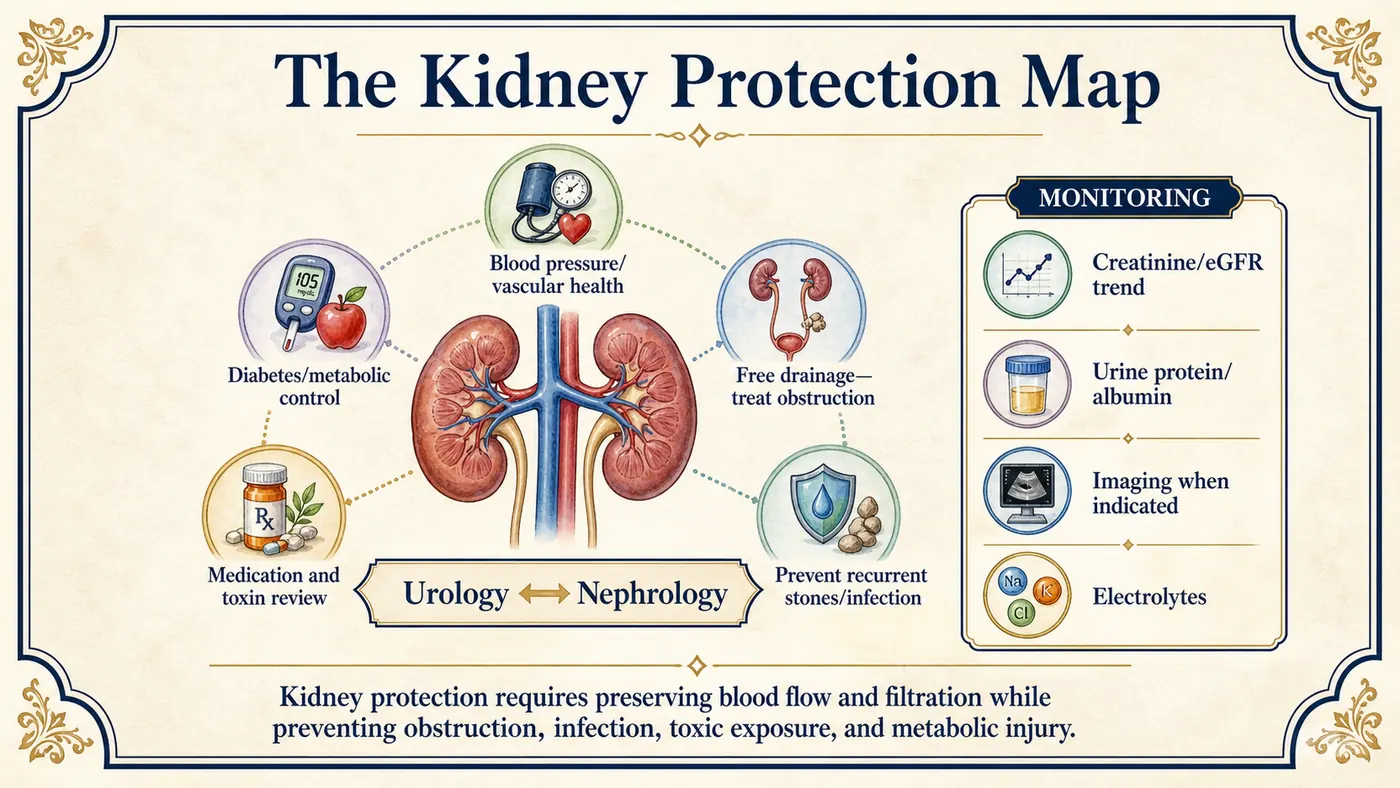
- Creatinine and estimated filtration rate are trends, not complete diagnoses.
- Urine protein or albumin shows kidney injury that imaging cannot.
- High blood pressure and diabetes are major drivers of chronic kidney disease.
- A medication tolerated for years can become risky during vomiting, diarrhea, fever or dehydration.
- Simple kidney cysts are extremely common and usually need no treatment.
- Urologists focus on drainage, stones, masses and procedures; nephrologists on filtration and kidney disease. Many patients need both.
Kidney reserve is quiet until it is not
Kidneys can lose substantial function without causing any pain, so problems are often found only through blood and urine tests. Protection therefore depends on measurement, risk control and relief of reversible blockage. Urology and nephrology overlap but ask different questions. Urologists often focus on drainage, stones, masses, anatomy, infection and procedures. Nephrologists focus on filtration, protein loss, kidney disease throughout the body, electrolytes and blood pressure. Many people need both perspectives, working together.
Read the trend, not one number
Creatinine and estimated filtration rate (eGFR) are trends, not complete diagnoses. Muscle mass, hydration, acute illness and medication changes can shift them. Urine protein or albumin adds information about kidney injury that imaging cannot provide.
Time scale matters. A sudden change over days suggests a different problem from a slow decline over years. Acute illness, dehydration, urinary retention, blockage of both kidneys or of a single kidney, medications and infection can cause reversible injury that needs prompt action. A gradual decline raises broader questions about blood pressure, diabetes, protein loss, vascular disease and cumulative injury. A stable number in someone with little reserve still deserves protection; a mildly abnormal value during an acute illness may recover.
That is why earlier results are so valuable. Bring old blood tests, urine protein results, blood-pressure records, diabetes information, scans and a full list of medicines and supplements. A stable pattern may support monitoring; a rapid change may call for prompt repeat testing, medication review, imaging, drainage or coordinated care with a kidney specialist.
What threatens kidney function
High blood pressure and diabetes are major drivers of chronic kidney disease. Smoking, vascular disease, recurrent blockage, infection, stones and certain medications add injury. Anti-inflammatory pain relievers (NSAIDs) may be appropriate in selected situations, including stone pain, but repeated or high-risk use can impair kidney function, especially during dehydration or illness or when reserve is limited. Supplements and extreme protein regimens should be disclosed rather than assumed harmless.
Hydration should be tailored. Too little can worsen stones and stress the kidneys; drinking indiscriminately large amounts can be dangerous with heart, liver or advanced kidney disease. Contrast imaging is sometimes essential and should be managed with risk-reduction steps rather than avoided by reflex.
Medication safety during vulnerable periods
A medication tolerated for years can become risky during vomiting, diarrhea, fever, poor intake or blockage. NSAIDs, diuretics, blood-pressure drugs, diabetes medicines, contrast and supplements may need review during acute illness. Do not stop essential therapy on reflex, but know whom to call when an illness changes the usual balance. Kidney protection works best when your urologist, nephrologist and primary clinician each know what the others are trying to preserve. Unrecognized blockage, repeated infected blockage, medication use during illness and lost follow-up are among the most preventable causes of kidney injury.
When a scan finds a kidney cyst or mass
An incidental finding is not an automatic emergency. The word mass describes something visible. It does not say whether a finding is benign, malignant, aggressive or in need of immediate treatment. Ask for the finding to be named precisely: simple cyst, complex cyst, solid enhancing mass or indeterminate lesion.
- Simple cysts are extremely common and usually need no treatment.
- Complex cysts are categorized by imaging features that estimate cancer risk and guide surveillance or treatment.
- Solid enhancing masses need a different evaluation, but even small ones vary in behavior, and some can be safely observed in selected patients.
High-quality contrast imaging helps characterize a finding. A biopsy is most useful when the result can change management; a nondiagnostic biopsy does not prove a mass is benign. Young age, masses in both kidneys or several masses, or a suggestive family history may warrant genetic counseling.
When treatment is needed, partial nephrectomy preserves kidney tissue and is prioritized for many small localized masses, especially when reserve is limited. Ablation can treat selected tumors with less operative burden. Radical nephrectomy remains appropriate when complexity or safety makes it the better choice. Active surveillance is structured imaging and reassessment, not denial, and should name the scan type, interval, the responsible clinician and what would prompt a biopsy or treatment. Preserving enough working kidney for your future is part of a successful cancer outcome.
Questions to ask your urologist
- Is the change in my kidney function acute, chronic or related to blockage?
- Should both a urologist and a nephrologist be involved in my care?
- Which of my medicines or supplements need review, especially when I am sick?
- If a kidney finding was seen, exactly how is it classified, and how certain is that classification?
- Would a biopsy change the plan, and how do surveillance, ablation and surgery compare for cancer control and kidney preservation?