Key points
- The pad looks the same; the physiology is not.
- Mixed leakage is common and often needs more than one treatment target.
- Giving a storage medication to someone whose bladder is already overfilled can worsen the problem.
- Not everyone needs urodynamics before treatment; testing should match uncertainty and risk.
- Conservative treatment is not merely a delay before surgery.
- Cutting fluids indiscriminately is rarely the answer.
Incontinence is not one condition
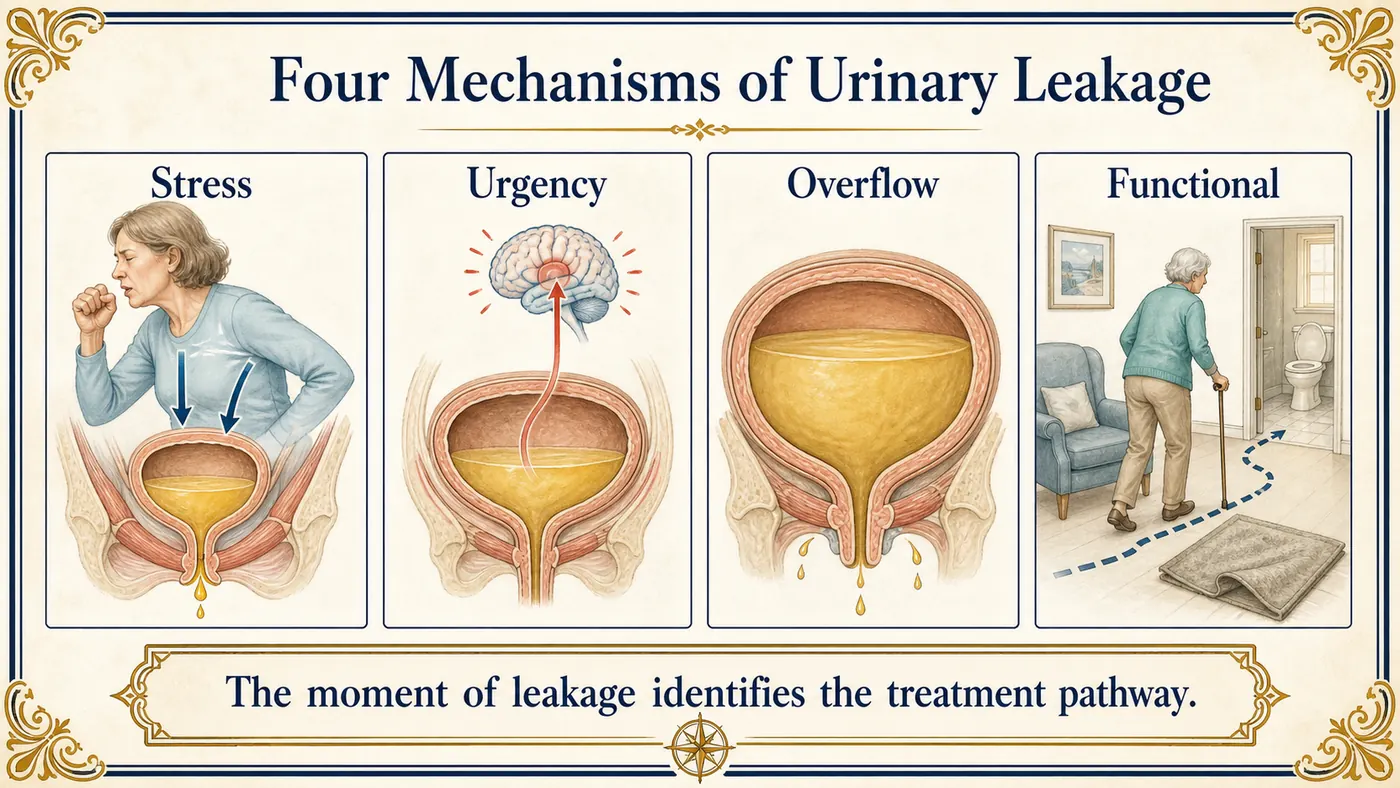
Many people think incontinence is incontinence. Someone may leak when coughing, on the way to the bathroom, and occasionally without feeling the bladder at all, and find that neither exercises nor medication fixes it. Usually that is not because the problem is untreatable. It is because more than one type of leakage is present. The moment and mechanism of the leak tell you which system failed.
The four types
- Stress incontinence: pressure from coughing, laughing, sneezing, lifting or exercise overcomes the support and closure of the urethra.
- Urgency incontinence: a compelling bladder signal is followed by leakage before you reach the bathroom.
- Overflow leakage: an overfilled bladder that does not empty properly releases urine.
- Functional incontinence: mobility, memory or thinking, clothing, the environment or access to help prevents timely toileting, even if the urinary tract works reasonably well.
Mixed leakage is common and often needs more than one treatment target.
Your history often identifies the type
What were you doing when the leak happened? Did it follow a cough or jump? Did urgency come first? Is it constant? Do you feel empty afterward, and is your stream weak? How many pads do you use, and are they damp or soaked? Did it begin after childbirth, pelvic surgery, prostate treatment, radiation, a neurologic event or a new medication?
A bladder diary, urinalysis, examination, a cough stress test and a measurement of urine left after voiding often answer the first questions. In a woman who leaks with coughing, the examination may look at pelvic support, tissue quality, prolapse and whether the pelvic floor can both contract and relax. When overflow is possible, abdominal fullness, neurologic findings, flow and residual urine matter more than the pad itself.
Not everyone needs urodynamics, a detailed bladder-pressure study, before treatment. A healthy woman with clearly demonstrated, uncomplicated stress incontinence can often decide on treatment after a focused evaluation. Testing becomes more valuable when symptoms are mixed, emptying is abnormal, neurologic disease is present, prior surgery changed the anatomy or the proposed treatment justifies more certainty.
Treatment matched to the type
Stress leakage in women may improve with weight management when relevant, pelvic-floor muscle training, a continence pessary or other support device, urethral bulking, or surgery such as a sling after proper evaluation. Pelvic-floor training must be taught correctly; endlessly squeezing without relaxation or coordination is not always helpful.
Urgency leakage follows the urgency pathway: bladder training, trigger management, pelvic-floor strategies, medication, and selected nerve-stimulation or bladder-directed procedures.
Overflow leakage needs attention to emptying: medication review, drainage, treatment of the outlet, a neurologic evaluation, pelvic-floor coordination or catheterization.
Leakage after prostate treatment deserves its own careful evaluation. Recovery can continue over time, and pelvic-floor rehabilitation may help. Persistent, bothersome stress leakage may lead to discussion of a male sling or an artificial urinary sphincter, depending on severity, radiation history, anatomy, hand function, goals and prior procedures. Hand strength, memory and the ability to operate a device matter as much as anatomy.
Functional leakage often improves with scheduled toileting, easier clothing, bedside equipment, mobility support, lighting, caregiver planning and medication review. A perfect bladder treatment cannot overcome a locked bathroom door or an unsafe walk.
Define your goal
Some people want complete dryness. Others want to return to tennis, stop changing clothes at work, sleep without soaking a pad or avoid an operation. Leaking a drop during a hard cough is a different decision from emptying most of the bladder before reaching the toilet.
Conservative treatment is not simply a delay before surgery. Properly taught pelvic-floor therapy can improve strength, timing, pressure management and confidence. Weight loss may reduce stress leakage when excess weight contributes. Bladder training can increase warning time in urgency incontinence. Devices can provide support for specific activities. These approaches may be the long-term plan or prepare you for a later procedure.
Procedures need equally careful matching. Urethral bulking may appeal to a woman who wants a lower-burden treatment and accepts that repeat treatment may be needed. A sling may give more durable control but brings surgical and mesh-related considerations that deserve an informed discussion.
The effects people rarely mention
Chronic wetness can injure skin, cause odor, disrupt sleep and burden caregivers. Fear of leaking can lead to dehydration, constipation, less exercise, social isolation and avoidance of intimacy. These effects can become more disabling than the leakage itself. Cutting fluids indiscriminately is rarely the answer: concentrated urine irritates the bladder, and dehydration can worsen constipation, dizziness, stones or infection risk. A better plan works with your volumes, timing and triggers while protecting hydration.
Incontinence is not a character flaw and not an inevitable price of aging. It is a mechanical, sensory, functional or mixed problem that can be measured and treated. Success may be sleeping through the night, returning to exercise or using one security pad instead of organizing the day around accidents.
Questions to ask your urologist
- Which type, or combination of types, of leakage do I have?
- Am I emptying my bladder adequately?
- Should my pelvic-floor therapy focus on strengthening, relaxation or both?
- Which nonsurgical and procedural treatments fit my situation and goals?
- How do childbirth, prior prostate treatment, radiation or neurologic disease change my options?