Key points
- Sudden inability to urinate needs immediate care, even without pain.
- Drinking more water cannot force a blocked bladder open and can make the pain worse.
- The prostate is a common cause in men, but scar tissue, stones, clots, constipation, medications, a weak bladder muscle, the pelvic floor and the nerves can all be involved.
- A large residual confirms incomplete emptying; it does not identify the mechanism.
- A catheter protects drainage while the cause is found; it is not the diagnosis and is often not permanent.
- Chronic retention is judged by its effects: infections, stones, kidney changes and quality of life.
When the bladder cannot finish the job
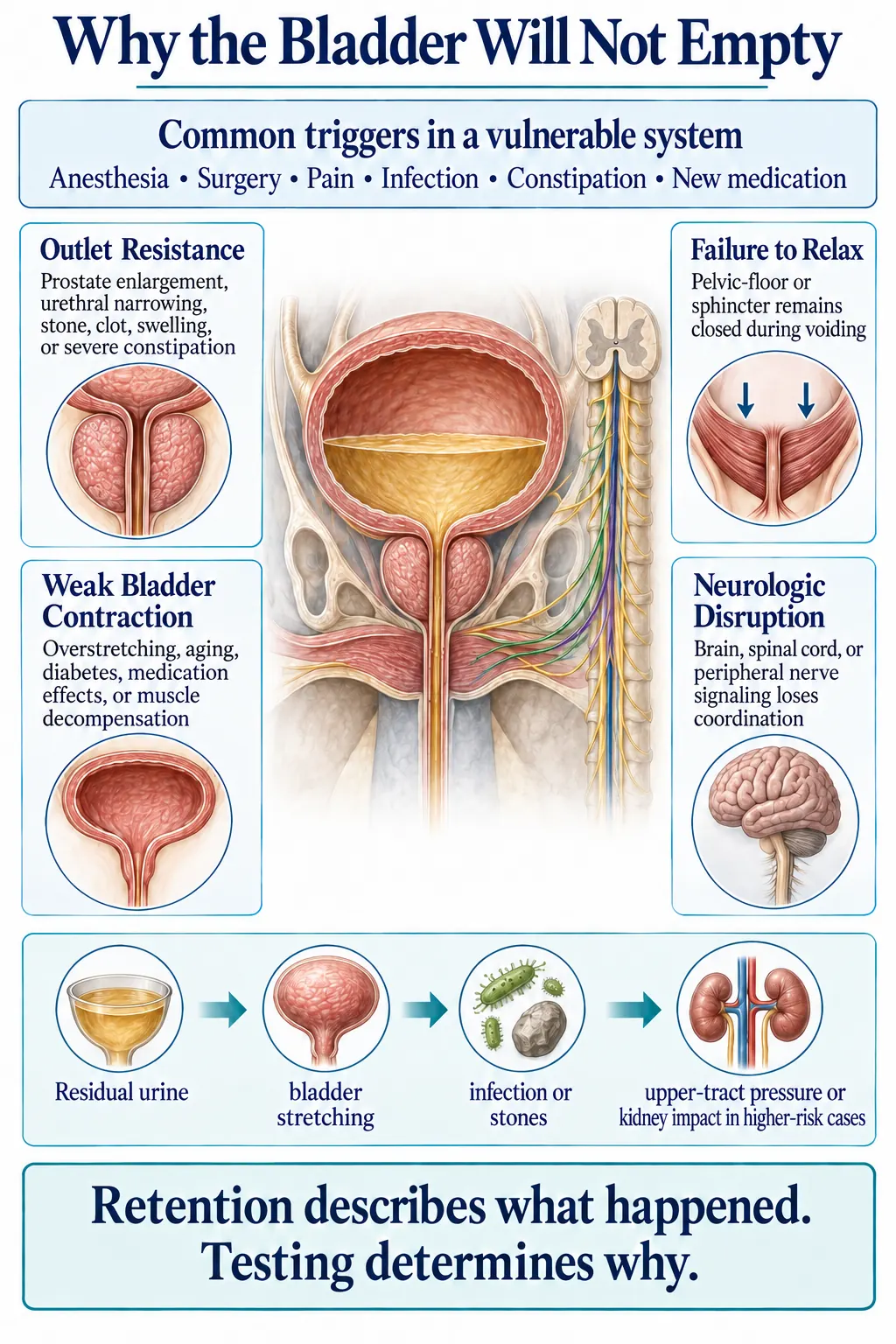
Urinary retention tells you that the bladder did not empty. It does not tell you whether the outlet resisted, the bladder weakened, the pelvic floor failed to relax or the nervous system lost coordination. Retention is the result. The mechanism still has to be found.
An enlarged prostate is a common cause of retention in men. But the outlet may also be narrowed by scar tissue, a stone, a clot, swelling, constipation or another anatomical problem. The bladder muscle may be too weak to generate an effective contraction. Anesthesia, pain, medication, surgery, infection or neurologic disease may disrupt a system that was previously compensating.
Acute and chronic retention do not feel the same
Acute retention usually announces itself: a powerful urge, lower abdominal pressure or pain, repeated unsuccessful attempts to urinate and growing distress. Some people leak small amounts around a full bladder and assume that leakage proves they are emptying. It does not. Drinking more water to flush the blockage through only makes the pain worse, because the bladder keeps filling and still cannot drain.
Chronic retention can be quiet. The bladder stretches gradually, sensation may diminish, and you may adapt to a weak stream, prolonged voiding, frequent small trips, dribbling or the feeling that urination is never quite complete. Some people feel surprisingly little despite retaining a substantial volume. Pain is not a reliable measure of severity.
Chronic retention also varies in risk. Stable incomplete emptying with normal kidney function, no swelling of the kidneys, no recurrent infections and manageable symptoms is different from retention accompanied by kidney deterioration, stones, recurrent infection, skin injury from overflow leakage or severe impairment of daily life. The effects matter more than the number.
The bladder is both a reservoir and a pump
During filling, the bladder must stay relaxed enough to store urine at low pressure while the outlet stays closed. During urination, the bladder muscle must contract while the outlet and pelvic floor relax. Retention can occur when any part of that sequence fails, and more than one part can fail at once.
- Outlet resistance. Prostate size and obstruction are not interchangeable; a moderately enlarged gland positioned at the outlet may resist more than a larger one. Urethral scar tissue can affect men or women. Stones, clots, swelling after a procedure and significant constipation can also impair emptying.
- A weakened bladder muscle. Longstanding resistance, severe overstretching, diabetes and other neurologic conditions, aging, pelvic surgery, spinal disease, medications and illness may reduce contraction. Relieving obstruction may help, but a weakened bladder may not recover completely.
- Failure to relax. Pain, anxiety, learned habits, a tight pelvic floor or poor coordination can keep the channel from opening. The goal here is coordination and down-training, not simply strengthening.
- Neurologic disruption. Stroke, multiple sclerosis, Parkinsonian disorders, spinal cord injury, disc disease, diabetes and pelvic nerve injury can disrupt the circuit between the brain, spinal cord, nerves and sphincter.
Retention often appears when a vulnerable system loses its remaining margin. Antihistamines, decongestants, some bladder medications, certain antidepressants and antipsychotics, opioids and sedatives can worsen emptying, and anesthesia, postoperative pain, immobility, intravenous fluid and interruption of usual prostate medication can combine after surgery. Do not stop a prescription on your own; your clinicians can decide whether to hold, adjust or substitute it.
The first step in acute retention is drainage
When a painful, full bladder cannot empty, the immediate treatment is generally drainage with a catheter. This relieves pressure, measures the retained volume and buys time to find the cause. After urethral surgery, known narrowing, trauma or failed attempts, experienced urologic help may be needed, because repeated forceful attempts can cause injury.
Drainage does not mean you will need a permanent catheter. Often the trigger is temporary or treatable, and a period of drainage lets the bladder recover while constipation, infection, medication effects or outlet resistance are addressed. In selected men with suspected prostate-related retention, an alpha blocker may improve the chance of passing a later voiding trial, though it is not right for everyone.
A voiding trial asks whether the bladder and outlet can now work together. The catheter is removed, you urinate, and the voided amount and residual may be measured. Producing a few drops is not passing. The result helps decide whether you need more recovery time, medication, intermittent catheterization, an indwelling or suprapubic catheter, further testing or treatment of the outlet.
Chronic retention: treat risk, symptoms and cause
Not every chronic residual demands the same intervention. The questions are whether retention is causing harm and what created it. Prostate-directed medication or a procedure may help when outlet resistance is convincingly present. Urethral narrowing needs its own pathway. Pelvic-floor dysfunction may respond to therapy. A neurologic bladder may need pressure assessment and long-term kidney protection. A weak bladder may need intermittent catheterization or another drainage strategy when emptying cannot be restored reliably.
Intermittent catheterization is often preferable to a long-term indwelling urethral catheter when it is feasible. The choice depends on hand function, cognition, caregiver support, anatomy, infection history, comfort, lifestyle and goals; a suprapubic catheter may suit selected people who need longer-term drainage. The catheter is one tool for protecting drainage while the larger plan is built.
When retention threatens the kidneys
The kidneys drain continuously into the bladder. When bladder pressure stays high or the outlet stays severely obstructed, pressure can extend back to the kidneys. Swelling of the kidneys, infection, unstable kidney function and severe obstruction on both sides increase urgency. One functioning kidney leaves less reserve, and fever with retention suggests infected urine that cannot drain.
If emptying has declined gradually, pay attention to your stream, straining, time needed to void, infections, leakage and the feeling that urine remains. Bring a complete medication list and note neurologic symptoms, constipation, prior pelvic procedures and recent changes. The right treatment begins by finding which part of the system stopped doing its job.
Questions to ask your urologist
- Is my retention acute, chronic or both?
- Does outlet resistance, bladder weakness or poor coordination best explain it?
- Has the retention affected my kidneys or upper urinary tract?
- Could my medications, constipation, recent surgery or a neurologic condition be contributing?
- When should we try a voiding trial, and would uroflow, cystoscopy, ultrasound or urodynamics change treatment?
- If normal emptying can’t be restored, which drainage option fits my health and daily life?